
A viewing is a fact-finding exercise, not a sales pitch. Fresh paint and carefully placed furniture can make a house feel right, but they won’t tell you whether the roof needs attention or how much the heating costs. The right questions to ask when viewing a house help you look beyond the polished details and identify what needs checking.
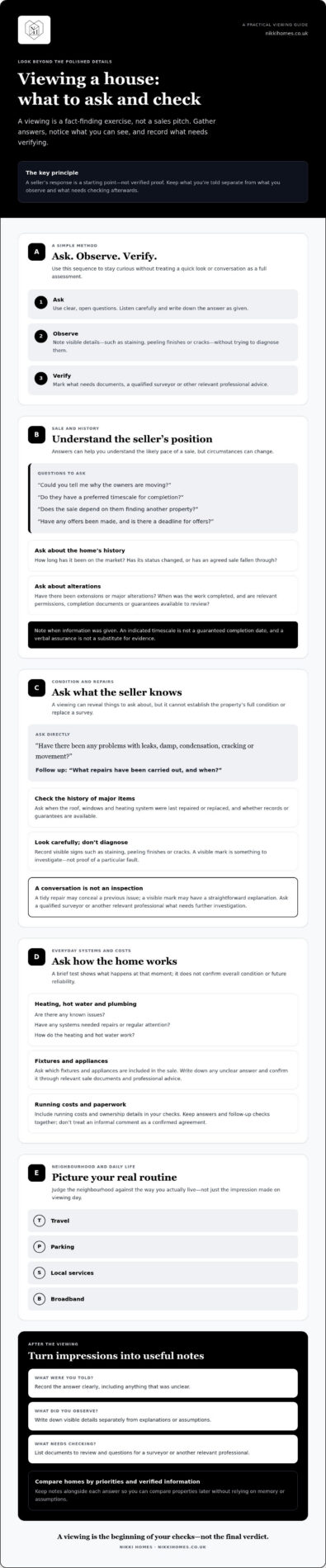
You’re right to want clear answers before making an offer. A seller’s response is a starting point, not always a verified fact. Note what you’re told, what you can observe and what needs checking afterwards, so you don’t have to rely on memory or assumptions.
This practical checklist covers the property’s condition, running costs, ownership details and neighbourhood. It also gives you a straightforward way to record answers, compare homes after each viewing and decide what to investigate next. Go in prepared, stay curious and give yourself room to make a confident decision.
Key Takeaways
- Use the questions to ask when viewing a house to keep the conversation focused on details that matter.
- Ask about known issues, previous repairs and recurring maintenance, but don’t mistake a viewing for a full assessment of the property.
- Separate what you’re told from what needs evidence, and record follow-up checks alongside each answer.
- Judge the neighbourhood against your real routine, including travel, parking, local services and broadband.
- Compare properties against your priorities and verified information, not just the impression they made on viewing day.
Questions to Ask When Viewing a House: Start With the Sale
Ask calmly, listen carefully and write down the answers. A viewing is a chance to gather information, not a moment to commit to buying. These questions to ask when viewing a house can help you understand the seller’s position and identify what needs checking later. Treat answers as useful leads, not proof. Confirm important details through relevant documents and professional advice.
Questions about the seller’s reason and timescale
You don’t need to press for personal details. A straightforward question can reveal whether the seller’s plans might align with yours:
- “Could you tell me why the owners are moving?”
- “Do they have a preferred timescale for completion?”
- “Does the sale depend on them finding another property?”
- “Have any offers been made, and is there a deadline for offers?”
The answers may help you understand the likely pace of a sale, but circumstances can change. If timing matters, ask the agent to clarify the seller’s current position and note when you received the information. An indicated timescale is not a guaranteed completion date.
Questions about the home’s history and changes
Ask how long the property has been on the market and whether its status has changed, for example, if it was previously listed or an agreed sale fell through. Then ask what alterations or extensions have been made, when the work took place and whether paperwork is available.
- “Have there been any extensions or major alterations?”
- “When was the work completed, and are there documents I can review?”
- “Are there any relevant permissions, completion documents or guarantees?”
A verbal assurance isn’t a substitute for evidence. Note what was said, then ask for relevant documents to be checked as part of the purchase process. A viewing also can’t establish the home’s full condition. A professional home inspection is a separate, objective examination, so don’t treat a quick look around as a substitute for appropriate checks.
Questions About a House’s Condition, Repairs and Hidden Problems
A viewing can help you spot things to ask about, but it can’t establish the property’s full condition or replace a survey. Use your questions to ask when viewing a house to learn what the seller knows, while keeping visible clues separate from conclusions. A mark on a wall, for instance, is something to record and investigate, not proof of a particular fault.
Questions about damp, movement, the roof and major repairs
Ask directly, without suggesting an answer: “Have there been any problems with leaks, damp, condensation, cracking or movement?” Follow up with “What repairs have been carried out, and when?” You can also ask when the roof, windows and heating system were last repaired or replaced, and whether there are records or guarantees.
Look carefully, but don’t diagnose. Note visible signs such as staining, peeling finishes or cracks, and ask whether the seller knows their history. A tidy repair may conceal a previous issue, while a visible mark may have a straightforward explanation. Neither is settled by a quick conversation. Record what you see and hear, then ask a qualified surveyor or another relevant professional what needs further investigation before relying on an explanation or deciding how to proceed.
Questions about heating, plumbing and everyday systems
Ask how the heating and hot water work, whether the seller knows of any faults, and whether any systems have needed repeated attention. If practical, ask to see a system operating. A brief test only shows what happens at that moment. It doesn’t confirm the system’s overall condition or future reliability.
- “Are there any known issues with the heating, hot water or plumbing?”
- “Have any of these systems needed repairs or regular attention?”
- “Which fixtures and appliances are included in the sale?”
Write down the exact answer, especially if it’s unclear whether an item is included or a repair was temporary. Confirm those details through the relevant sale documents and professional advice rather than treating a viewing-day comment as an agreement. For wider background on costs and stages, the US Consumer Financial Protection Bureau’s home buying process guide may be useful, but it’s written for a US audience, so check UK-specific details with appropriate professionals.
If you’re unsure how to weigh a seller’s answer against what you observed, experienced, straight-talking property guidance can help you plan sensible next steps. Explore property guidance from Nikki Homes.
Questions About Ownership, Running Costs and Property Paperwork
Use the viewing to ask for an outline, then use documents and professional advice to confirm the detail. Questions to ask when viewing a house can reveal what needs checking, but an answer from the seller or agent isn’t a formal record and shouldn’t replace conveyancing or other checks.
Questions about tenure, boundaries and shared responsibilities
Ask whether the property is freehold or leasehold. If it’s leasehold, ask about the service charge, ground rent and lease details, then have your conveyancer verify the terms and paperwork. Where relevant, ask about shared access, boundaries, rights of way and responsibility for communal areas or shared structures. A quick answer can point you in the right direction, but it can’t settle what you’re legally responsible for.
Questions about bills, council tax and energy information
Ask for recent utility-cost information and the council tax band. Bills depend on household usage, the tariff and the period covered, so request examples or statements if available and treat them as a guide, not a forecast. Check the band independently with the relevant council or official source. Ask whether an Energy Performance Certificate (EPC) is available, then check that it relates to the property and review its recommendations.
Keep a record that separates the answer from the evidence still needed. This simple table gives each follow-up a clear owner:
| Question | Answer received | Evidence needed | Follow-up owner |
|---|---|---|---|
| Is the property freehold or leasehold? | Write the exact answer | Title and lease information | Your conveyancer |
| What are the service charge and ground rent? | Record figures and period quoted | Lease and relevant accounts or documents | Your conveyancer |
| What are typical energy costs? | Note the period and usage context | Recent bills, if available | You, then confirm as needed |
| Which council tax band applies? | Record the band stated | Independent band check | You |
| Is there an EPC? | Note whether one was provided | Check the certificate and property details | You |
For a broader set of prompts, Redfin’s comprehensive checklist of questions may help you prepare. It’s written for a US audience, so UK tenure and paperwork checks still need UK-specific advice. If affordability or borrowing is part of your decision, discuss your circumstances with a mortgage adviser and use mortgage guidance to prepare your questions. Don’t treat a viewing-day estimate as a personalised assessment.
Questions to Ask About the Neighbourhood and Daily Life
A house can look peaceful during a short viewing and feel very different at school-run time, on a busy evening or at the weekend. The street is part of the purchase, so look beyond the front door. Ask about local routines, then check the details against your own.
Questions about noise, neighbours and access
Ask whether there are known noise issues, parking pressures or shared-drive arrangements. If access or maintenance is shared, find out how it works and which documents explain the arrangement. Answers are a starting point, not a substitute for checking relevant paperwork.
Return at another time if you can. Notice traffic, activity, street parking and how easy it is to get in and out. Try the routes you’d use regularly, on foot, by bicycle and by public transport. Consider whether an ordinary weekday journey would work for your household, not just whether the area feels appealing during the appointment.
- “Are there busy periods or regular sources of noise nearby?”
- “Is parking usually available, and are there any shared access arrangements?”
- “What are the usual options for getting to work or other regular destinations?”
Check broadband availability and performance at the specific address with providers or an independent checker. Coverage on the street doesn’t guarantee a suitable connection inside the property.
Questions about local services and future changes
Map the places you’ll actually rely on, such as shops, schools, healthcare, green space and public transport. In Stratford-upon-Avon and nearby villages, independently check journey times and access for the hours you’ll need them. Village amenities and transport options can differ from one location to another, so test the routine rather than relying on a general impression. If you’re comparing an established market town with a newer residential community, this comparison of Shipston-on-Stour and Meon Vale shows how everyday amenities and routines can differ.
Ask whether the seller knows of proposed nearby development, then verify relevant plans through the local authority’s planning information. If the property is riverside or low-lying, check the Environment Agency’s flood-risk information for England. A pleasant view or a seller’s recollection isn’t a reliable way to assess flood risk.
If the property includes land or equestrian facilities, factor in specialist checks on the land, access and facilities before assuming they’ll suit your needs. A general house viewing won’t answer every question those features raise.
Use these questions to ask when viewing a house to judge whether the location fits your daily life, not just the viewing-day mood. For local insight as you weigh up a property in Stratford-upon-Avon or the surrounding area, speak with Nikki Homes about local property.
After Viewing a House: Verify Answers and Choose Your Next Step
The viewing ends, but your fact-checking starts. Take a few minutes to capture what you remember before one property blurs into the next. The questions to ask when viewing a house only help if you can separate what you saw, what you were told and what still needs proving.
A simple post-viewing checklist
Use the same routine after every appointment. It makes comparisons fairer and stops unanswered questions disappearing into a busy inbox.
- Record: Write down the seller’s answers, your observations and any questions left open.
- Label: Mark each detail as observed, supported by evidence or stated verbally but unverified.
- Prioritise: Flag anything that could affect the property’s condition, your budget, ownership or ability to proceed.
- Assign: Decide who should follow up, such as you, the agent, your solicitor, surveyor or mortgage adviser.
- Request: Ask the agent for relevant documents or clarification, and note when you’ll check back.
Be precise. “The seller said the heating was serviced” is not the same as having a service record. “There’s a crack by the window” is an observation, not a diagnosis. Keep the original wording and any evidence together so a professional can see exactly what needs checking.
Deciding whether to revisit, investigate or move on
Compare each home against the same practical priorities: whether it suits your household, fits your budget and meets your non-negotiables. Separate essentials from preferences. A useful location may not outweigh a cost or unanswered issue you can’t accept, and a beautifully presented room shouldn’t distract from a concern that needs proper investigation.
Choose a next step for each property:
- Revisit if you need another look at a room, feature or detail that could change your decision.
- Investigate if an answer needs documents, a surveyor’s assessment, conveyancing checks or mortgage advice.
- Move on if the property doesn’t meet a firm requirement or verified information changes the picture.
A second viewing can help you focus on specific points, but it still isn’t a substitute for professional checks. Before making an offer, make sure you understand which questions remain open and who is responsible for resolving them. You don’t need instant certainty. You need a clear next step.
If you’re considering a home in Stratford-upon-Avon, Nikki Homes can offer property guidance as you weigh up what to do next. Start with the facts you have and the checks still to make, rather than feeling pressured to decide on the spot.
Make Your Next Move With Clearer Information
A strong viewing isn’t about deciding on the spot. It’s about leaving with useful answers, clear notes and a short list of checks to make. The questions to ask when viewing a house help you look beyond first impressions, whether you’re asking about the seller’s plans, the property’s condition, ongoing costs or the neighbourhood.
Keep each answer in its proper place: what you observed, what someone told you and what still needs evidence. Compare homes against your budget and priorities, then decide whether to investigate further, revisit or move on. If a detail could change your decision, get it checked by the right professional before relying on it.
Nikki Homes is an independent boutique estate agency based in Stratford-upon-Avon. If you’re weighing up a property or your next step, talk through your next move with Nikki Homes. Take the time to check what matters and make your decision with confidence.
Frequently Asked Questions
What questions should I ask when viewing a house for the first time?
Start with the seller’s reason for moving and preferred timescale, then ask about known issues, repairs, alterations and what’s included in the sale. Ask whether the property is freehold or leasehold, and what the running costs are. These questions to ask when viewing a house give you a useful starting point, not proof. In Stratford-upon-Avon, also consider how the location fits your regular journeys and day-to-day needs.
Can I ask why the owner is selling?
Yes, it’s reasonable to ask why the owner is selling and whether they have a preferred timescale. You could phrase it simply: “Could you tell me why the owners are moving?” The answer may help you understand their plans, including whether their sale depends on finding another property. Treat it as helpful context rather than a promise about timing, and ask the agent to clarify anything that could affect your plans.
What should I look for when viewing a house for signs of problems?
Look for visible clues such as staining, peeling finishes, cracks, signs of leaks or condensation, and note where you see them. Don’t try to diagnose the cause from a brief viewing. Ask whether the seller knows about the issue and whether repairs have been carried out. A viewing can’t establish the home’s full condition, so raise significant or uncertain concerns with a qualified surveyor before relying on an explanation or deciding what to do.
How do I find out whether a house is freehold or leasehold?
Ask the agent or seller whether the property is freehold or leasehold, then have your conveyancer verify the tenure through the relevant property documents. For a leasehold home, ask for details of the lease, service charge and ground rent so these can be checked properly. Don’t rely on a verbal answer alone. The documents and professional checks will help clarify the terms, responsibilities and costs linked to ownership.
Should I ask about damp when viewing a house?
Yes. Ask directly whether there have been problems with damp, condensation or leaks, and whether any repairs were made. If you spot staining, peeling paint or other visible signs, record their location and ask what the seller knows about them. These clues don’t confirm the cause, and a fresh finish doesn’t settle the question. If you remain concerned, ask a qualified surveyor to assess the issue before making decisions based on a viewing-day explanation.
What questions should I ask about a house’s running costs?
Ask for recent information about utility bills, the council tax band and, for leasehold properties, service charges and ground rent. Check the council tax band independently and ask to see supporting documents where available. Utility costs depend on household use, so previous bills are only a guide to that household’s consumption. Check the Energy Performance Certificate too, and consider how the property’s likely costs fit your budget alongside your mortgage and other commitments.
What should I do after viewing a house?
Write down what you observed, what you were told and what remains unanswered while the details are fresh. Mark which points need evidence, then assign follow-ups to yourself, the agent, your conveyancer, a surveyor or a mortgage adviser. Compare the property with your budget and priorities, not just your first impression. In Stratford-upon-Avon, revisit the area at another time if local traffic, access or daily routines could influence your decision.