
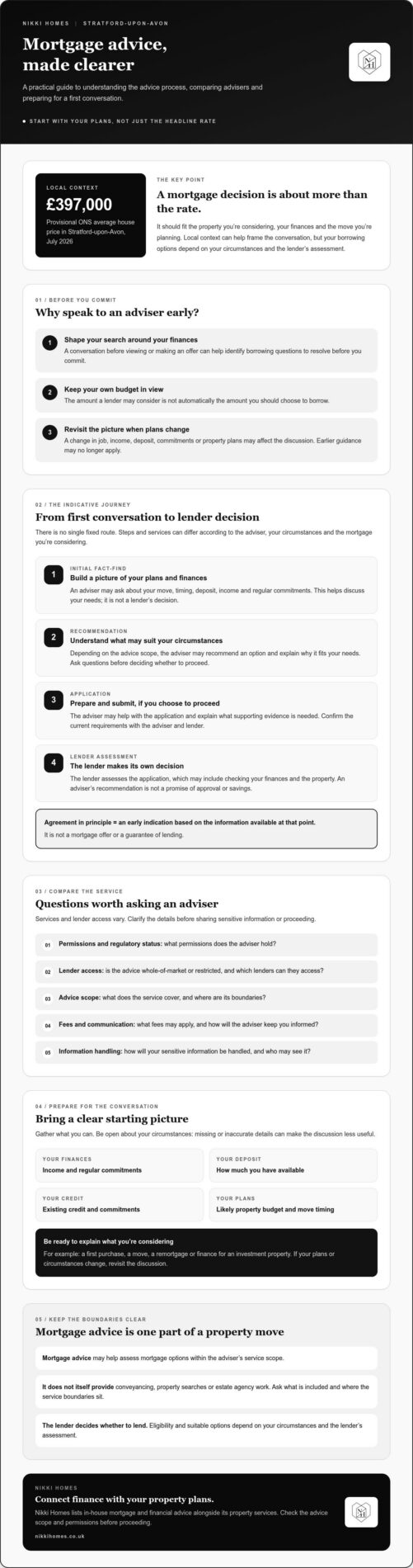
A mortgage decision isn’t just about the rate. It needs to fit the property you’re buying, your finances and the move you’re planning. If you’re searching for a mortgage advisor Stratford-upon-Avon, local context matters: provisional ONS figures put the town’s average house price at £397,000 in July 2026, so it’s worth understanding your borrowing options before you commit.
It’s reasonable to feel unsure about what you might borrow, whether you’ll meet a lender’s criteria or what mortgage advice includes. A useful conversation should clarify those points without leaving you with jargon or pressure. This guide explains what an adviser may help with, what to ask about advice scope, lender access, permissions and fees, and what information to gather before you speak.
Nikki Homes lists in-house mortgage and financial advice alongside its property services, giving you a local point of contact as you consider your wider move. Services differ, so check what the advice covers before proceeding. Read on for practical questions, preparation tips and next steps, whether you’re buying your first home, moving or exploring your options.
Key Takeaways
- Consider speaking to an adviser before viewing or making an offer, so you can discuss borrowing alongside your property plans.
- An adviser’s process may include an initial fact-find, a recommendation and an application, but the steps and service can vary.
- When comparing a mortgage advisor Stratford-upon-Avon, ask about regulatory status, lender access, advice scope, fees and communication.
- Gather details of your income, deposit, existing credit and likely property budget to make your first conversation more useful.
- Nikki Homes lists in-house mortgage and financial advice alongside property services. Check the advice scope and permissions before proceeding.
When a mortgage advisor in Stratford-upon-Avon can help with your move
Should you speak to an adviser before viewing, before making an offer or only once you’ve found a property? If you’re unsure about your borrowing needs or budget, an early conversation can help identify questions to resolve before you commit. A mortgage advisor Stratford-upon-Avon buyers consult should look beyond a headline rate and consider whether a mortgage fits their circumstances and plans.
A mortgage adviser gathers information about your finances and property plans, then may recommend options suited to your situation and the scope of their service. A mortgage broker can help connect borrowers with mortgage products, but services and lender access vary. A headline rate alone won’t tell you whether you meet a lender’s criteria, what other costs or features apply, or whether the product suits you. Advice is not a promise of approval or savings: the lender makes its own assessment.
What does a mortgage adviser actually do?
An adviser will typically ask about your income, regular commitments, deposit and the property or move you have in mind. That could be a first purchase, a move, a remortgage or finance for an investment property. If you have unique working arrangements or career-specific contracts, finding a broker experienced in your sector can also help—medical professionals, for instance, can learn more about Mortgages for Doctors to explore tailored borrowing options. Be open about your circumstances, as missing or inaccurate details can make the discussion less useful.
Mortgage advice is distinct from other parts of a property transaction. It doesn’t itself provide conveyancing, property searches or estate agency work. Those relate to legal checks, information about a property, and buying or selling property. Ask what the adviser’s service includes and where its boundaries sit.
When should Stratford-upon-Avon buyers seek advice?
Consider speaking to an adviser before making an offer, particularly if you’re unsure how much you can borrow or how a purchase fits your budget. This can help you shape your search around your finances rather than assumptions. Keep your own budget in view: the amount a lender may consider is not automatically the amount you should choose to borrow.
Plans can change. A new job, altered income, a change in deposit or existing commitments, or a shift from buying a home to considering an investment property may affect the discussion. Review your position when circumstances change rather than assuming earlier figures or guidance still apply. Whether you’re purchasing in Stratford-upon-Avon or planning a move elsewhere, eligibility and suitable mortgage options depend on your circumstances and the lender’s assessment.
How mortgage advice works, from first conversation to application
There isn’t one fixed route. The process is indicative, and steps can differ depending on the adviser, your circumstances and the mortgage you’re considering. A useful conversation should clarify what happens next, who is responsible and what still needs to be checked.
What happens in an initial mortgage discussion?
The adviser may begin by asking what you’re planning, when you hope to move, how much deposit you have, and about your income and regular commitments. This fact-find helps build a picture of your needs, but it isn’t a lender’s decision. The National Careers Service outlines what a mortgage adviser does, including discussing clients’ finances and mortgage options.
Before sharing sensitive information, ask how it will be handled and who may see it. Establish the adviser’s permissions, whether their advice is whole-of-market or restricted, which lenders they can access and what fees may apply. Don’t assume every adviser offers the same service.
From recommendation to lender decision
After reviewing your circumstances and the service available, an adviser may recommend an option and explain why it fits your needs. Ask questions before deciding whether to proceed. If you receive an agreement in principle, treat it as an early indication based on the information available at that point, not as a mortgage offer or guarantee of lending.
An adviser can recommend a mortgage; only the lender decides whether to lend.
If you proceed, the next stage is usually an application. The adviser may help prepare and submit it and explain what supporting evidence is needed. Requirements and checks vary, so confirm the current list with the adviser and lender rather than relying on a generic checklist. The lender assesses the application, which may include checking your finances and the property, then makes its own decision. There’s no guaranteed timescale or outcome.
Keep your information and plans up to date throughout. If your income, deposit, commitments or expected purchase changes, tell the adviser before the application moves forward. A mortgage advisor Stratford-upon-Avon can explain how the advice process may work for your plans, but first check the individual adviser’s status, service scope and fees. You can review Nikki Homes’ in-house mortgage and financial advice as a possible starting point, then ask what the service includes before sharing information or proceeding.
How to compare mortgage advisers in Stratford-upon-Avon
A low advertised rate is only one part of the decision. The mortgage with the smallest headline rate may not suit your circumstances, and a rate alone tells you little about the scope or quality of the advice. Compare what each adviser can offer, how they’re paid and how clearly they explain your options.
| What to compare | Questions to ask |
|---|---|
| Regulatory status | Who will advise you, and what permissions apply to them and the firm? |
| Lender access | Which lenders or products can they consider? Are any excluded? |
| Advice scope | Is the service described as whole-of-market or restricted, and what does that mean in practice? |
| Fees and commission | Will you pay a fee, could the adviser receive commission, and when might a charge apply? |
| Communication | Who is your point of contact, how will updates be given, and how can you ask follow-up questions? |
Check the detail, not just the label
“Whole-of-market” and “restricted” describe different service models. Neither label alone tells you whether the advice is right for you. Ask the adviser to explain their lender access, any limits and how they’ll compare options. Check the relevant Financial Conduct Authority register information and confirm the adviser’s permissions directly. If they’re an appointed representative, ask which firm they represent. Don’t rely on a job title or a confident sales pitch as proof.
Get a clear explanation of fees and commission before agreeing to proceed. Ask who will give the recommendation, what qualifications they hold and what happens if your circumstances change during the process. A mortgage advisor Stratford-upon-Avon should be able to explain the service in plain English, including what it doesn’t cover.
Local context and integrated services
A standalone mortgage-advice service may focus on borrowing, while a property agency may offer mortgage and financial advice alongside services such as residential sales, property sourcing or onward negotiation. An integrated setting may help connect a finance discussion with the wider property move, depending on the services provided. It isn’t automatically cheaper, faster or better, so compare the advice on its own merits.
Ask any adviser how their service fits your plans and which other professionals you may need. Clear boundaries make it easier to assess the advice and decide whether the working relationship suits you.
What to prepare before speaking to a mortgage adviser
You don’t need a perfect application file before an initial discussion. A clear picture of your finances and plans is a better starting point. If you’re speaking with a mortgage advisor Stratford-upon-Avon, use this checklist to organise the essentials, then ask what evidence is needed and how to provide it securely.
Information an adviser may ask about
- Your identity and household: who is applying, where you live and relevant personal details.
- Income and work: employment or self-employment, how you’re paid and any other income you want considered.
- Deposit: the amount available and where it comes from, such as savings or a family gift. A lender may ask for evidence of the source.
- Commitments and credit: regular bills, loans, credit cards, other borrowing and financial commitments.
- Property plans: whether you’re buying, moving, remortgaging or considering an investment property, and your likely timescale.
If the discussion moves towards an application, the evidence requested will depend on your circumstances and the adviser and lender involved. It may include proof of identity and address, bank statements, payslips and a P60 for employed applicants, or tax calculations and Tax Year Overviews for self-employed applicants. These are examples, not a complete or guaranteed list. Confirm current requirements directly, and don’t send sensitive documents until you know who is requesting them, why they’re needed and how to share them securely.
Build a property budget, not just a borrowing figure
Keep your deposit, likely mortgage borrowing and other purchase costs separate in your calculations. Alongside stamp duty, allow for costs such as legal work, a survey and moving. The amounts depend on your circumstances and choices, so check them individually rather than treating a borrowing estimate as your total budget.
Decide what monthly payment and overall spending feel manageable for you, not only what a lender might consider. This gives your conversation a practical boundary: explore borrowing in the context of property plans you can realistically sustain. For stamp duty, check the current rules that apply to your purchase rather than relying on an old estimate.
Preparing these details can make an initial conversation more focused, but it doesn’t establish eligibility or guarantee a lending decision. To discuss how in-house mortgage and financial advice may fit alongside your property plans, contact Nikki Homes about mortgage advice and confirm the service scope and document requirements before proceeding.
Nikki Homes mortgage advice: connect finance with your property plans
Property and borrowing decisions are closely connected, but they’re not the same service. Nikki Homes, an independent boutique estate agency in Stratford-upon-Avon, lists in-house mortgage and financial advice alongside residential property sales, property sourcing and onward negotiation. This gives you a local point of contact to ask about finance in the context of a possible move. It doesn’t, by itself, confirm what advice is available or how the services work together.
What can integrated property and mortgage support mean?
A property conversation may take place alongside a mortgage discussion. For example, if you’re considering a purchase, you could ask how your property plans relate to your borrowing needs. Having services listed within one agency may offer a convenient starting point, but don’t assume that everyone involved handles every part of your transaction, or that connected services will automatically be quicker, cheaper or more suitable.
Be clear about responsibilities. Mortgage advice concerns borrowing and the advice service provided; property sales, sourcing and onward negotiation are separate activities. Ask who you’ll speak to about each service, what it covers and whether you can use the mortgage advice independently of the agency’s property services. The right arrangement depends on your needs and the confirmed scope of each service.
How to take the next step with Nikki Homes
Before making contact, note the property you’re considering, your plans and timescale, and the questions you want answered. You don’t need to arrive with every document prepared. Start by understanding the service.
- Who would provide the mortgage advice, and what qualifications and permissions do they hold?
- Is the advice whole-of-market or restricted, and which lenders or products can be considered?
- What fees or commission may apply, and when would any charge be due?
- What is included, what falls outside the service, and is advice available if you’re not using Nikki Homes for a property transaction?
These are sensible checks for any mortgage advisor Stratford-upon-Avon residents are considering. Nikki Homes lists in-house mortgage and financial advice among its services, but verify the adviser’s current status, permissions, lender access, fees and availability directly before proceeding. Clear answers help you decide whether the service fits your plans, without assuming an outcome or committing before you understand the details.
If you’re weighing up a move, discuss your property plans with Nikki Homes and ask what mortgage and financial advice may be relevant to your situation.
Make your next property move with clarity
The right mortgage conversation should leave you clearer about your options, the questions still to resolve and what to prepare next. Before choosing a mortgage advisor Stratford-upon-Avon, check their permissions, advice scope, lender access and fees. An adviser may recommend an option, but the lender makes the final lending decision.
Nikki Homes is an independent boutique estate agency based in Stratford-upon-Avon, with in-house mortgage and financial advice listed among its services. Its team has over 55 years of combined experience across the business; this figure isn’t specific to mortgage advice. Ask directly about the adviser’s credentials, the service available and how it could relate to your property plans.
If you’re ready to explore your next step, discuss your property plans with Nikki Homes. Take your questions, understand the answers and choose a path that feels right for you.
Frequently Asked Questions
Do I need a mortgage advisor to buy a home in Stratford-upon-Avon?
No, you don’t have to use a mortgage adviser to buy a home, but advice may help you understand options and prepare before making an offer. You can approach lenders directly, while an adviser’s lender access and advice scope depend on their service model. If you’re considering a mortgage advisor Stratford-upon-Avon, check their permissions, fees and support before deciding whether the service suits your needs.
How do I check whether a mortgage adviser is authorised in the UK?
Check the Financial Conduct Authority’s Financial Services Register for the adviser or firm, and confirm directly who will provide your advice and under which firm’s permissions. Some advisers operate as appointed representatives of another firm, so check that relationship too. Make sure the permissions cover the service being discussed. If anything is unclear or details don’t match, ask the firm to explain before sharing information or proceeding.
What is the difference between a mortgage adviser and a mortgage broker?
The terms are often used interchangeably in the UK, with no clear distinction in everyday use. Both may help you compare mortgage options and, depending on their service, recommend a suitable product or arrange an application. What matters is the individual service: ask which lenders can be considered, whether advice is whole-of-market or restricted, what the adviser will do and how they’re paid.
Can a mortgage adviser help if I am self-employed?
Yes, an adviser may be able to discuss mortgage options with you if you’re self-employed, although acceptance depends on your circumstances and the lender’s assessment. Be ready to explain how your income is earned and how it varies. Lenders may ask for evidence such as tax calculations and Tax Year Overviews, but requirements differ. Confirm the current documents needed with the adviser and lender before applying.
How much does mortgage advice cost in the UK?
There’s no single fee that applies to every mortgage adviser or service. Some may charge a fee, receive commission from a lender or use a combination; arrangements vary. Ask for a clear explanation of any fee, commission and when a charge could become payable before agreeing to proceed. Don’t assume an initial discussion is free. Check the adviser’s written terms so you understand the full cost of the service.
Can I speak to a mortgage adviser before I have found a property?
Yes, you can speak to an adviser before finding a property. An early conversation may help you understand what information they’ll need and discuss borrowing plans before you view or make an offer. It won’t guarantee a mortgage or confirm what a lender will ultimately offer. If your income, deposit or plans change, tell the adviser, as this may affect the options considered or the application.
What documents should I take to a mortgage adviser appointment?
For an initial appointment, take notes on your income, deposit, regular commitments, credit and property plans; you may not need documents straight away. If evidence is requested, it could include identification, proof of address, bank statements and payslips. Self-employed applicants may be asked for tax calculations and Tax Year Overviews. Requirements vary, so confirm the current list and secure document-sharing method before sending sensitive information.