
Three online tools give you three different figures. An estate agent offers another. So, what is your home really worth? A house valuation can give you a grounded estimate, but it isn’t a guaranteed sale price, however confidently it’s presented.
It’s understandable to want one clear number before you sell, move or make plans. The trouble is that different valuations serve different purposes, and an automated estimate can’t fully account for your home’s condition, layout, improvements or the details of its location. Nor does an agent’s market appraisal replace a formal surveyor valuation when one is needed.
This guide explains what each type of valuation can and can’t tell you, which evidence can support or challenge an estimate, and how to choose a sensible next step. You’ll see how comparable sales, property-specific details and your reason for seeking a valuation all matter, so you can weigh the figures without mistaking an estimate for a promise.
Key Takeaways
- Separate an estimated value, an asking price and an agreed sale price before making plans around a figure.
- When comparing estimates, ask what comparable sales, dates and property assumptions sit behind each one.
- A higher figure isn’t automatically more reliable; different methods and information can lead to different house valuation estimates.
- Before an appraisal, gather accurate details about tenure, floor area, layout changes, improvements and relevant documents.
- Afterwards, ask what supports the estimate, what could affect buyer appeal and where the uncertainty lies.
What does a house valuation tell you about your home?
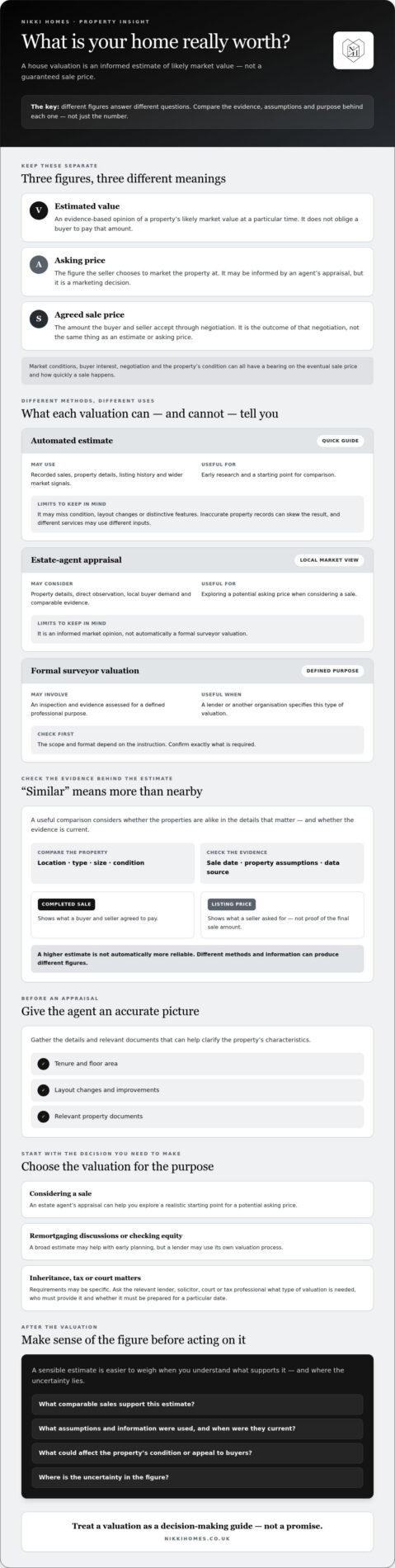
A valuation estimates a property’s likely market value at a particular time. It’s an informed opinion based on evidence, not a fixed amount a buyer must pay. The figure is only useful when you know what it was prepared for, what information it relies on and when that information was current.
That distinction matters. An estate agent’s market appraisal is generally intended to help a homeowner consider a potential asking price. An asking price is the figure a seller chooses to market the property at; an agreed sale price is what a buyer and seller accept through negotiation. A formal surveyor valuation is a separate professional assessment, which may be needed for a specific purpose. The wider idea of real estate appraisal also involves different approaches to assessing value, rather than one universal figure.
Even a carefully considered house valuation can’t guarantee the eventual sale price or how quickly a sale will happen. Market conditions, buyer interest, negotiation and the property’s condition all have a bearing. Treat the figure as a useful point for making decisions, not a promise.
Is a house valuation the same as a sale price?
No. A valuation is an evidence-based opinion; it doesn’t oblige buyers to offer that amount. Imagine an agent estimates a home’s likely market value and the seller sets an asking price informed by that advice. A buyer may then offer less, or another buyer may offer more. The agreed price emerges through negotiation and depends on the circumstances at the time.
Those figures answer different questions: the valuation estimates likely value, the asking price is a marketing decision, and the agreed sale price records the outcome of a negotiation. None should be casually treated as interchangeable.
When might you need a valuation?
If you’re considering selling, an agent’s appraisal can help you explore a realistic starting point. For remortgaging discussions or checking your equity, a broad estimate may help with early planning, but your lender may use its own valuation process. Inheritance, tax or court matters can have specific requirements, so don’t assume an estate-agent appraisal will be accepted.
Ask the lender, solicitor, court or relevant tax professional what type of valuation they need, who must provide it and whether it must be prepared for a particular date. The right figure is the one suited to the decision you need to make.
How are online house valuations and professional appraisals worked out?
Different methods answer different questions. An online estimate uses data to produce a quick guide; an estate agent’s market appraisal adds an informed view of the individual property and local buyer demand; a formal surveyor valuation is prepared for a defined professional purpose. None should be judged by the number alone. Ask what evidence, assumptions and date sit behind it.
Comparable evidence is central, but “similar” needs to mean more than nearby. A useful comparison considers location, property type, size, condition and when the sale took place. Completed sale prices show what buyers agreed to pay; listing prices show what sellers asked for. They’re not interchangeable, and a high asking price isn’t proof that a property sold for that amount.
| Method | Typical inputs | Strength | Limit | Suitable use |
|---|---|---|---|---|
| Automated estimate | Recorded sales, property details, listing history and wider market signals | Quick starting point for comparison | May miss condition, layout changes or distinctive features; inaccurate records can skew the result | Early research, not a final pricing decision |
| Estate-agent appraisal | Property details, direct observation, local demand and comparable evidence | Can account for features and buyer appeal that data may not capture | An informed market opinion, not automatically a formal surveyor valuation | Considering a sale or likely asking price |
| Formal surveyor valuation | Inspection and evidence assessed for a defined purpose | Prepared as a professional assessment for the relevant requirement | Scope and format depend on the instruction; confirm what is required | When a lender or other organisation specifies this type |
What data can an online house valuation use?
Providers may draw on completed-sale records, basic property characteristics, past and current listings, and broader market movements. HM Land Registry publishes records of completed property sales in England and Wales; portals can provide listing information. The precise inputs vary by service, so check its explanation rather than assuming every estimate uses the same data.
A missing extension, incorrect bedroom count or outdated floor area can pull an estimate off course. So can a model that treats a home as typical when its layout or condition is anything but. If two online figures differ, compare their assumptions and data dates before deciding either is “wrong”.
What can an in-person estate-agent appraisal add?
An agent can see the layout, condition, improvements and features that a database may not record, then consider how those details compare with local buyer demand. An appraisal can add useful property-specific context, but it isn’t a surveyor’s report or a substitute for a formal valuation if a lender or another organisation requires one.
If you’re weighing up a move in Stratford-upon-Avon, a local conversation can help put an automated estimate into context. Explore local property advice as one possible next step.
House valuation myths: why different figures are not automatically wrong
Different figures don’t automatically mean someone has made a mistake. An online model, an agent and a surveyor may be working from different information, using different methods or answering different questions. The useful test isn’t which number sounds best. It’s whether the assumptions and evidence behind it stand up to scrutiny.
Nor does a higher estimate prove an agent is exaggerating to win your instruction. It may reflect a different view of buyer demand or the property’s appeal. But a confident figure without a clear explanation deserves questions. You’re entitled to understand the reasoning before you base a decision on it.
Does the highest house valuation mean you can sell for more?
No. An ambitious asking price is a choice about how to market a home; it isn’t evidence that buyers will pay that amount. A grounded appraisal should be supported by relevant comparisons and a reasoned view of what buyers may respond to. One high figure, on its own, tells you little about the likely outcome.
If an estimate sits well above the others, ask the agent to explain which comparable properties support it, whether those figures are asking prices or completed sale prices, and how the differences between those homes and yours have been considered. Ask the same of a notably low estimate. A clear answer matters more than a flattering one.
Why can two house valuations disagree?
One estimate may use a different set of recorded sales or listing information; another may reflect a later date or a different view of the property’s size, type or condition. Local coverage can vary too. A model relying on broad patterns may struggle to assess a home with an unusual layout, a distinctive conversion or improvements that aren’t accurately recorded. A person may spot those details, but their opinion still depends on the evidence and judgement they apply.
Compare the figures systematically. Check:
- Property facts: Are the address, type, floor area, bedrooms and layout accurate?
- Evidence: Are the comparisons genuinely similar, and are they completed sales or asking prices?
- Timing: When was the estimate produced, and how old is its supporting information?
- Assumptions: Does it account for condition, improvements and features that make your home different?
If one figure changes substantially when a basic detail is corrected, that’s a clue about its sensitivity to the underlying data, not proof that every other estimate is right. Ask each source to show its working. You can then judge which figure has the most relevant support, rather than simply choosing the highest or averaging them.
How to prepare for a Stratford-upon-Avon house valuation
Good preparation isn’t about dressing your home up or trying to steer the figure. It’s about giving the person assessing it accurate facts, a clear account of changes and a fair view of its condition. Presentation can help someone see the space, but fresh paint or a tidy garden doesn’t guarantee a higher valuation.
What information should you have ready?
Before your appointment, pull together the details that an online record or a quick viewing might miss. Use this checklist to get organised:
- 1. Check the basics. Confirm the address, property type, number of rooms and floor area, if known. Flag anything you believe is wrong in online records and ask the relevant provider how to correct it.
- 2. Note the tenure. Record whether the property is freehold or leasehold. If leasehold, have the information you hold about the lease available.
- 3. Describe layout changes. List extensions, conversions or other alterations, with approximate dates where known. Gather relevant planning permissions, building regulations documents or certificates if you have them.
- 4. Record improvements. Note significant upgrades, what was done and when. Keep invoices or certificates that help explain the work, but don’t assume an improvement adds a fixed amount to the value.
- 5. Present the home clearly. Tidy, declutter and deal with minor repairs where practical. You don’t need to undertake cosmetic work solely to influence an appraisal.
How should Stratford-upon-Avon comparables be assessed?
Look for completed sales of homes that are genuinely comparable in location, property type, size, layout and condition. Check when they sold, too: an old sale may reflect a different market. Nearby asking prices can offer context, but they show what sellers hoped to achieve, not necessarily what buyers paid.
Location needs a closer look than a map radius. A town-centre property, a home in a residential part of Stratford-upon-Avon and one in a surrounding village may attract different buyers and shouldn’t automatically be treated as direct comparisons. Ask how an agent has accounted for those differences and for any distinctive features in your own home.
The same careful eye is useful on viewings. See our guide to questions to ask when viewing a house to help you assess a property beyond its asking price.
If you’re preparing to sell, an in-person discussion can help put your property details and relevant local evidence into context. Arrange a Stratford-upon-Avon property valuation with Nikki Homes as a practical next step, without treating the estimate as a guaranteed sale price.
What happens after a local house valuation?
A useful valuation conversation should leave you with more than a headline figure. Ask what evidence supports the opinion, which details about your property were assumed, and what could shift the assessment. If an agent gives you a range, ask how its upper and lower ends are grounded. A range without an explanation is just a pair of guesses.
What should you ask the person valuing your home?
Keep the discussion practical and specific. Ask:
- Which comparable completed sales support your view, and when did they sell?
- How do those homes compare with mine in location, size, condition and layout?
- Which property details or assumptions could materially change your assessment?
- What buyer appeal do you see, and what might make a buyer hesitate?
- If I decide to sell, how would you use and respond to feedback from viewers?
The answers help you distinguish a reasoned opinion from a number chosen to sound reassuring. They also give you something concrete to revisit if the market response differs from expectations. A house valuation remains an estimate, not a guarantee of the price or timing of a sale.
How can valuation advice support your next move?
A grounded estimate can help you think through whether to sell now, prepare first or wait, and how a move might fit with your plans. If you’re buying another home, use the estimate as one planning input, not as a promise about how much equity you’ll release. Your available funds and borrowing options need separate consideration; speak with an appropriate mortgage adviser about the finance for your next purchase.
You can ask questions and consider your options without committing to instruct the agent. A valuation conversation is a chance to understand the evidence and discuss what a sale might involve. It doesn’t oblige you to put your home on the market.
If you’d like a local perspective in Stratford-upon-Avon, Nikki Homes is an independent boutique agency offering free, honest property valuations. Take the next step when it suits you: Request a free, honest property valuation.
Make your next property decision with confidence
A house valuation is a reasoned estimate, not a promise of the price you’ll achieve or how quickly you’ll sell. Online figures and agent opinions can differ because their evidence, assumptions and purpose differ. The strongest estimate is the one that can be clearly explained, with comparable sales and your property’s details taken into account.
Before deciding what to do next, check your home’s facts, ask how the valuation was reached and consider whether you need an informal market appraisal or a formal valuation for a specific purpose. You don’t have to commit to selling just because you’ve asked for an opinion.
Nikki Homes is an independent boutique estate agency based in Stratford-upon-Avon, with over 55 years of combined team experience. Its free valuations and bespoke residential sales support can help you explore your options with honest, property-specific advice. Request a free, honest property valuation and take your next step with greater clarity.
Frequently Asked Questions
How accurate is an online house valuation?
An online house valuation is a useful starting point, not a guaranteed sale price. Its accuracy depends on the property details and data available to the provider, and on how closely comparable nearby homes match yours. It may not reflect condition, layout changes or unusual features. Check your details, compare the estimate with recent local sales, and seek a local agent’s or surveyor’s property-specific advice if you’re making an important decision.
Can I get a house valuation for free?
Yes. Some property portals provide online estimates without charge, and Nikki Homes offers free, honest property valuations in Stratford-upon-Avon. Check what the service includes: an automated estimate is different from an agent’s appraisal, and neither is necessarily a formal surveyor valuation. Ask what evidence supports the figure and what it’s intended for. A free appraisal can inform your thinking, but it can’t guarantee a sale price.
Why are house valuations different from one estate agent to another?
Agents may rely on different comparable sales, data dates and assumptions, or form different views of local buyer demand. They may also interpret your home’s condition, layout and improvements differently. A gap between opinions doesn’t automatically mean one agent is being dishonest. Ask each to explain which nearby completed sales they consider comparable, how those properties differ from yours, and what details could materially change their assessment.
Does renovating a house increase its valuation?
Renovations can influence how buyers view a property, but they don’t guarantee a pound-for-pound increase in value. The effect depends on the work, its quality, local buyer preferences and evidence from comparable homes. Keep records of substantial alterations, including dates and relevant paperwork, and share them during an appraisal. Don’t assume the project’s cost equals the value it adds. Ask the valuer to explain how they’ve considered the improvements.
What is the difference between an estate-agent valuation and a surveyor valuation?
An estate-agent appraisal is generally an opinion of likely market value to help you consider a potential sale. A surveyor valuation may be required for a specific formal purpose, such as a lender or legal matter, and must meet that organisation’s requirements. The two aren’t automatically interchangeable. Before arranging one, ask the organisation requesting it what format it needs and whether the valuation must be provided by a particular professional.
Should I trust a house valuation based on the whole of Warwickshire?
Treat a county-wide estimate as broad context, not a precise assessment of your home. It may not reflect your street, property type or condition. For a home in Stratford-upon-Avon, relevant comparisons should match its location and features as closely as possible; a town-centre property, for example, may not be directly comparable with one in a surrounding village. If you’re considering a sale or financial decision, seek a local, property-specific opinion.
How often should I check my house valuation?
Check when you have a practical reason, such as planning a sale, considering a move or reviewing your understanding of your equity. Online estimates can change as their data and market conditions change, but checking frequently doesn’t replace a property-specific appraisal. Before acting on a figure, confirm your home’s details are accurate and look for current comparable evidence. For a Stratford-upon-Avon property, local context matters as much as the headline estimate.