
Mortgage advice is optional, but it can help you find a clearer route to a suitable deal. An estate agent with a mortgage adviser can help you compare mortgage options, assess your finances and identify lenders whose criteria may suit your application. You can also apply directly to a lender without taking advice.
Buying a home involves more than arranging a mortgage. The property, application and people involved all need to move forward together. Advice can help bring those moving parts into focus, without suggesting every borrower needs the same solution.
This guide explains how an adviser can help you compare deals, prepare and manage an application, and consider remortgaging when your circumstances change. You’ll also learn how mortgage advice can fit alongside property services and what to expect when the two are coordinated. Get clear answers first, then decide what support makes sense for your move.
Key Takeaways
- Mortgage advice is optional, but an adviser can compare suitable deals and help match your finances to lenders’ acceptance criteria.
- Understand which lenders an adviser can access: a broad panel may still exclude deals available only by applying directly.
- Prepare your income and spending records early, and know how an adviser can help manage the application and lender communication.
- Before remortgaging, weigh the new deal against your existing mortgage and any early repayment charge.
- Clear coordination between your mortgage adviser and property professionals can help keep the purchase moving and clarify who handles each step.
Why do I need mortgage advice?
Mortgage advice can help you compare deals, understand lender criteria and organise your next steps, whether you’re buying, moving or remortgaging.
Advice for buying, moving and remortgaging
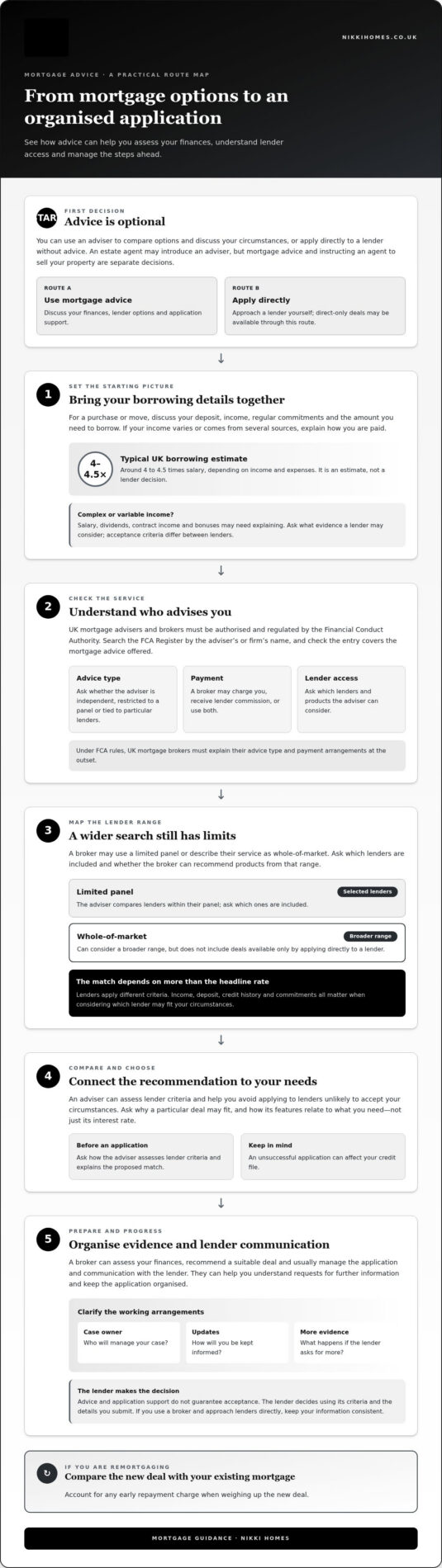
An estate agent may introduce you to a mortgage adviser, but you decide whether to use that service. The agent can recommend an adviser; the adviser assesses your circumstances and discusses mortgage options. You can apply directly to a lender without advice, so consider whether tailored guidance or a direct application better suits your needs.
For a home purchase or move, discuss your deposit, income, regular commitments and the amount you need to borrow. A typical UK borrowing estimate is 4 to 4.5 times salary, depending on income and expenses. For a remortgage, compare the new deal with your existing mortgage and account for any early repayment charge.
Ask the adviser what type of advice they provide, which lenders they can access and how they’re paid. Under Financial Conduct Authority rules, UK mortgage brokers must explain their advice type and payment arrangements at the outset. Fees vary: a broker may charge you, receive lender commission or use both.
Yes. You can use an estate agent’s mortgage adviser without instructing that agent to sell your property. Mortgage advice and a sales instruction are separate decisions, so clarify what service you’re agreeing to before proceeding.
Support for complex income
Self-employed applicants and people with variable or multiple income sources can use advice to present their finances clearly. Explain how you’re paid, including salary, dividends, contract income or bonuses, then ask what evidence a lender may consider. Lenders have different acceptance criteria, so an adviser can help assess how your circumstances may fit.
Before choosing an adviser, ask how they assess complex income, whether they have broad or limited lender access, and what documents they’ll need. A useful explanation should show how your income and regular outgoings affect affordability, rather than relying only on a headline salary multiple.
Adviser support and mortgage applications
A broker can assess your finances, recommend a suitable deal and usually manage the application and communication with the lender. This can help you understand requests for further information and keep the application organised. It doesn’t guarantee acceptance: the lender decides based on its criteria and the details you submit.
Ask who will manage your case, how they’ll keep you updated and what happens if the lender requests more evidence. Also ask how to complain if you believe a recommendation was unsuitable. You can use a broker and approach lenders directly, but keep your information consistent across applications.
Using the same estate agent and adviser may make communication more convenient, but convenience shouldn’t come at the expense of understanding each role. Ask whether the recommendation is based on your needs, how the adviser is paid and whether using their advice is optional.
Checking adviser authorisation
Mortgage advisers and brokers in the UK must be authorised and regulated by the Financial Conduct Authority. Search the FCA Register by the adviser’s or firm’s name, then check that the entry covers the mortgage advice being offered. Make sure the details match the person or firm you’re dealing with.
To find an estate agent with mortgage advice near you, search by town or area, then check the adviser’s FCA Register entry. Before proceeding, ask which lenders they can consider, how they’re paid and whether their advice covers buying, moving or remortgaging. These questions clarify the service and its limits.
Access to a panel of lenders and mortgage deals
A mortgage broker’s lender access determines which deals they can compare for you. Focus on understanding the scope, rather than assuming every adviser searches the entire market.
Some brokers work with a limited panel of lenders; others describe their service as whole-of-market. Ask which lenders are included and whether the broker can recommend products from that range. Lenders apply different acceptance criteria, so the right match depends on your income, deposit, credit history and commitments, not just the headline interest rate.
A broker can help you avoid applying to lenders unlikely to accept your circumstances. That matters because an unsuccessful application can affect your credit file. Before applying, ask how the adviser will assess lender criteria and explain why a particular deal may fit your situation. A clear recommendation should connect the product’s features to your needs, rather than present a rate without context.
Whole-of-market access has limits: whole-of-market mortgage brokers don’t have access to direct-only deals, which are available by applying directly to the lender. Some advisers also use a restricted panel, while some banks offer deals through their own channels. So “whole of market” doesn’t mean every possible mortgage is included.
Are mortgage advisers offered by estate agents independent or tied to specific lenders? Either arrangement is possible. In the UK, only advisers who offer customers a choice can call themselves independent, so ask whether the adviser is independent, restricted to a panel or tied to particular lenders.
How do estate-agent mortgage advisers compare with whole-of-market mortgage brokers? It depends on lender access: an estate-agent adviser may use a limited panel, while a whole-of-market broker can consider a broader range but still excludes direct-only deals. Ask what each service covers, then compare the answers with your priorities.
UK lenders offer some mortgages with deposits as low as 5%, and sometimes with no deposit. The deposit requirement is only one part of the decision: compare the lender’s criteria, the mortgage’s overall features and whether the product suits your plans. A smaller deposit may narrow the deals available to you, depending on lender requirements.
Use these questions to clarify the scope before proceeding:
- Which lenders and products can you consider for my circumstances?
- Are any deals available only by applying directly to a lender?
- How do you compare interest rates, fees and other product features?
- Will you explain why a lender or deal fits my needs?
The answers should make clear what the adviser can search and where direct applications may offer another route. For advice alongside a property move, explore in-house mortgage and financial advice.
Mortgage adviser support and application administration
A mortgage adviser can help organise your financial details into a coherent application. Brokers usually manage the application and communicate with the lender on your behalf.
Application preparation and paperwork
Start by giving the adviser a complete picture of your circumstances: income, regular spending, existing borrowing and deposit. The Mortgage Broker says full applications usually require your last three months of payslips and bank statements. Gather those records together, then check that the figures and dates match across your documents.
A Mortgage in Principle can help you understand your position before making an offer. According to The Mortgage Broker, it may be available in around 15 minutes using a soft search that doesn’t affect your credit score. It isn’t the full application, so keep your supporting paperwork ready for the lender’s later assessment.
Ask the adviser to explain each stage, who submits the forms and how lender requests will reach you. If the lender asks for clarification, respond with the specific evidence requested and keep a copy. Clear, consistent information matters: differences between your application and bank statements that aren’t explained can prompt follow-up questions.
Support for self-employed applicants
Self-employed applicants may need to explain how their income is generated and how consistently they receive it. Tell the adviser whether you work as a sole trader or through a limited company, and describe any changes in earnings. The lender assesses the evidence against its criteria, so organise relevant records before the application begins.
For example, if your income includes a company salary and dividends, distinguish each amount instead of combining them. The adviser can help identify what the lender needs and organise the information clearly. If your earnings fluctuate, explain why and provide context for the figures in your application.
Preparation also means flagging changes early. Tell the adviser if your income, deposit or financial commitments change before the lender makes a decision. A new commitment can affect affordability, while missing or inconsistent documents may delay an assessment. Don’t leave a material change unexplained or assume an earlier estimate still reflects your circumstances.
Keep the process organised: provide accurate details, submit the requested documents, then respond promptly to lender questions. Your adviser can coordinate these steps and explain each request, but the lender makes the lending decision. Direct applications remain an option; if you use a broker and apply directly, keep your information consistent.
Mortgage advice is most useful when you understand what support it includes. Ask who will manage your case, how updates will be shared and what happens if the lender requests more evidence. In the UK, advisers and brokers providing regulated mortgage advice must be authorised and regulated by the Financial Conduct Authority.
Remortgaging
Remortgaging means replacing your current mortgage with a new deal, often with another lender. It gives you a chance to review your borrowing, payment structure and plans for the property. Start by checking when your current deal ends, what you owe and whether leaving early would trigger an early repayment charge. That charge can affect whether switching now makes financial sense.
Timing matters. According to The Mortgage Broker, 1.8 million fixed-rate mortgage deals were expected to end in 2026. If your deal is approaching its end, compare available options before the current rate expires. Consider the overall cost and terms, not just the advertised interest rate. A mortgage adviser can help assess your circumstances and explain how a proposed deal compares with your existing arrangement.
For a buy-to-let property, make its rental purpose clear from the outset. Ask how the adviser will assess the mortgage in light of your plans, income and existing borrowing, and which lender criteria apply. If you’re remortgaging a home you now intend to let, explain the change before applying. Real estate investments and buy-to-let properties carry distinct considerations compared to owner-occupied homes, so your application must reflect how you use the property.
Ask whether the adviser is independent or works from a restricted lender panel. In the UK, only mortgage advisers who offer customers a choice can call themselves independent. Also ask how the adviser is paid and what the advice covers; the Financial Conduct Authority requires mortgage brokers to explain their advice type and payment arrangements at the outset. This helps you understand the recommendation and any charge before proceeding.
Before switching, work through a clear comparison:
- Check your current deal’s end date and any early repayment charge.
- Compare the proposed deal’s rate, fees, terms and repayment structure.
- Tell the adviser about changes to your income, borrowing or property plans.
- Ask what happens if your application or property circumstances change.
Keep up repayments on your existing mortgage while considering a switch. If you don’t keep up mortgage repayments, your home may be repossessed. Your credit and financial circumstances also matter: a lender assesses your application against its criteria, so a deal that looks attractive may not suit you. An adviser can explain the trade-offs and help you weigh the decision before committing.
Remortgaging isn’t only about finding a lower rate. Consider the total cost of switching, the terms you’ll accept and whether the mortgage fits your future plans. Bring your current mortgage details and intended use of the property to the discussion, then ask for a straightforward explanation of the recommendation.
Coordination with lenders, valuers, estate agents and solicitors
A property purchase involves several professionals, each responsible for a different part of the transaction. Your mortgage adviser deals with the lender and application; the valuer assesses the property for the lender, while your solicitor handles legal work. The estate agent communicates with the buyer and seller about the sale’s progress. Clear responsibilities help prevent missed messages and duplicated paperwork.
Once you’ve chosen a mortgage deal, ask your adviser what happens next and who will contact the lender. Mortgage brokers usually manage the application and communicate with lenders on your behalf. Keep requested documents together, respond promptly to questions and tell the adviser if your deposit or financial circumstances change. Consistent information across your application and supporting documents helps the lender assess your case.
The lender’s valuation is part of its mortgage decision, not a substitute for your own assessment of the property. If the valuation affects the amount the lender will offer, ask the adviser how that changes your borrowing and deposit. For example, a lower valuation could mean reviewing your funds, renegotiating the purchase price with the seller or reconsidering the property before committing further.
Your solicitor and mortgage adviser have separate responsibilities. The solicitor handles legal enquiries and conveyancing; the adviser deals with mortgage matters and the lender. If the lender requests property-related information, pass the request to the relevant professional and tell the adviser once you’ve done so. This gives everyone a clear action and reduces the chance of information going unanswered.
An estate agent can help keep the sale moving by sharing updates between buyer and seller. Agree who will communicate changes to the expected completion date, survey findings or outstanding paperwork. If the lender needs more time, tell the estate agent and solicitor promptly. They can then manage their respective parts of the transaction without working from different assumptions.
Use a simple progress list to keep track of the moving parts:
- Record lender requests and the date you sent each document.
- Note valuation updates and any effect on the mortgage offer.
- Keep your solicitor informed about mortgage progress and timing.
- Tell the estate agent about changes that affect the sale timetable.
These steps help organise the purchase, but they don’t remove your responsibility to keep up mortgage repayments. If you don’t, your home may be repossessed. For joined-up support with your property move, discuss your property plans.
Nikki Homes: Residential Property Sales
When you’re ready to turn mortgage plans into a property move, Nikki Homes can help with the property side. Its Residential Property Sales service supports buyers and sellers through the transaction, while onward negotiation can help connect the next steps. If you’re still searching, Property Sourcing offers another route; Property Auctions may suit buyers considering auction properties.
Choose support that fits your position, whether you’re buying, selling, searching or considering an auction. A clear property plan can help coordinate your purchase with your mortgage application and the other professionals involved.
To discuss your property plans, contact Nikki Homes.
Make your next property move with clarity
Your next step is to turn the mortgage decision into a clear property plan. Before viewing homes or making an offer, decide what you need from your next move, what matters most in a property and which questions still need answers. An estate agent with a mortgage adviser can bring property and finance conversations closer together, helping you make each decision with a fuller picture.
Nikki Homes offers Residential Property Sales, Lettings Services and Property Sourcing. Whether you’re preparing to sell, looking for a home to buy or searching for a property, choose the support that fits your next move. A focused conversation about your plans can help you decide where to begin, without committing to a property decision before you’re ready.
Contact Nikki Homes for mortgage advice and take the next step towards a property plan that feels considered and your own.
Frequently Asked Questions
How do I apply for a mortgage?
Choose whether to apply directly to a lender or seek advice from a mortgage adviser. Work out a monthly payment that fits your budget, then submit an application with accurate details about your income, spending and deposit. The lender assesses your finances and the property before deciding whether to make an offer. Read the offer’s conditions carefully and make sure they suit your plans before accepting.
What is an estate agent with an in-house mortgage adviser?
An estate agent with an in-house mortgage adviser brings property services and mortgage and financial advice together within one business. At Nikki Homes in Stratford-upon-Avon, property discussions can sit alongside in-house mortgage advice. The adviser discusses finance; the estate agent handles property matters. These are distinct roles, and using an in-house adviser doesn’t oblige you to take their advice or apply through a particular lender.
What are the risks of using the same estate agent and mortgage adviser?
Using the same estate agent and mortgage adviser may make communication more convenient, but don’t assume the advice is compulsory or independent. Clarify each person’s role, which lenders the adviser can access, how they’re paid and whether the recommendation is based on your needs.