A high asking price can leave a good house waiting. If you’re worried that your estate agent isn’t selling your house, start by reviewing the price against current buyer demand and comparable local sales. In the UK, the average time to sell, measured from listing to a sale subject to contract, is 64 days, but a listing with no credible offer after six weeks deserves a close look.
It’s frustrating when viewings are scarce or feedback goes quiet, especially if you believe your home is priced fairly. But time on the market is only one clue. The asking price, online presentation and marketing all affect whether buyers take the next step. If you’re wondering why your estate agent is not selling your house, this article explains what to review, when to ask for a clearer plan and what to check in your agreement before changing agents. You’ll be better placed to decide whether to adjust the price, improve the marketing or make a change.
Key Takeaways
- Before switching agents, read your agreement carefully for cancellation fees and any exclusivity period that may still apply.
- Judge the asking price against recent comparable sales and buyer response, not just the initial valuation.
- Review the listing’s portal visibility, photos and property details if interest has stalled, then ask your agent for a specific plan.
- Ask what price is likely to prompt offers and what practical changes could improve viewings before deciding your next move.
1. Changing estate agents
Changing agents can give your sale a fresh start, but only if the strategy changes too. Compare the asking price with recent completed sales, and ask what the current marketing has done to attract enquiries and viewings. If your agent can’t explain the interest, feedback or next steps clearly, request a specific plan. A new name alone won’t fix a pricing or presentation problem.
One example shows why pricing deserves a direct review. The first agent left the asking-price strategy untouched after 2 to 3 weeks. The point isn’t that every switch delivers the same result. It’s that a change can prompt a fresh assessment of the price and how potential buyers see the property.
Comparable sales can help test that assessment. But sales are not interchangeable: location, condition and buyer demand all matter. Ask your agent to explain which recent sales genuinely match your home.
To complain about an estate agent in the UK, raise the issue in writing with the agency and follow its complaints process. Estate agents must belong to an approved redress scheme. If the complaint remains unresolved, you can escalate it to that scheme.
Before instructing a replacement, set out what needs to improve: price advice, buyer follow-up, viewing feedback or the listing itself. Ask your current agent what price could prompt offers, then compare that advice with recent local sales. If the evidence points to a pricing issue, switching without changing the asking price may carry the same obstacle into a new campaign.
2. Checking cancellation fees and exclusivity clauses before switching
Read your estate agency agreement before instructing a replacement. Check the cancellation terms, notice requirements, any fee and the length of the sole agency period. Confirm whether that period has ended, as switching too soon could leave you responsible for contractual costs. Keep a copy of the agreement and ask the agency to explain any clause you don’t understand before giving notice.
You can change agents, but your agreement sets out the process and any fees you might owe. Check whether the sole agency period has ended, whether notice is required and what the cancellation clause says. Don’t assume that stopping the marketing ends your obligations. Get the agency’s position in writing and keep its response.
Accepting a low offer may mean giving up more than you need to, while switching agents without addressing the asking price or marketing may change little. Compare the offer with recent local sales, the buyer’s position and your moving plans before deciding. Ask your agent to explain its recommendation and negotiation strategy, then weigh those points against the terms of a new instruction.
For local trends, compare recent sold prices for similar nearby homes using HM Land Registry records. Rightmove, Zoopla and OnTheMarket show asking prices and current competition, but those are not completed sales. Match properties by location, size and condition. A home on a main road may not be a useful comparison for one on a quieter street.
Before you switch, make a written checklist: confirm the exclusivity period has ended, identify any cancellation fee, follow the notice process and agree when your current instruction finishes. Ask how outstanding viewings and potential buyers will be handled, and clarify whether the outgoing agency considers any buyer to have been introduced by it. This can help avoid confusion if an offer arrives during the changeover.
If a fresh sales strategy is the next step, explore residential property sales and compare the proposed approach with your priorities before making a decision.
3. When to review an estate agent’s marketing strategy
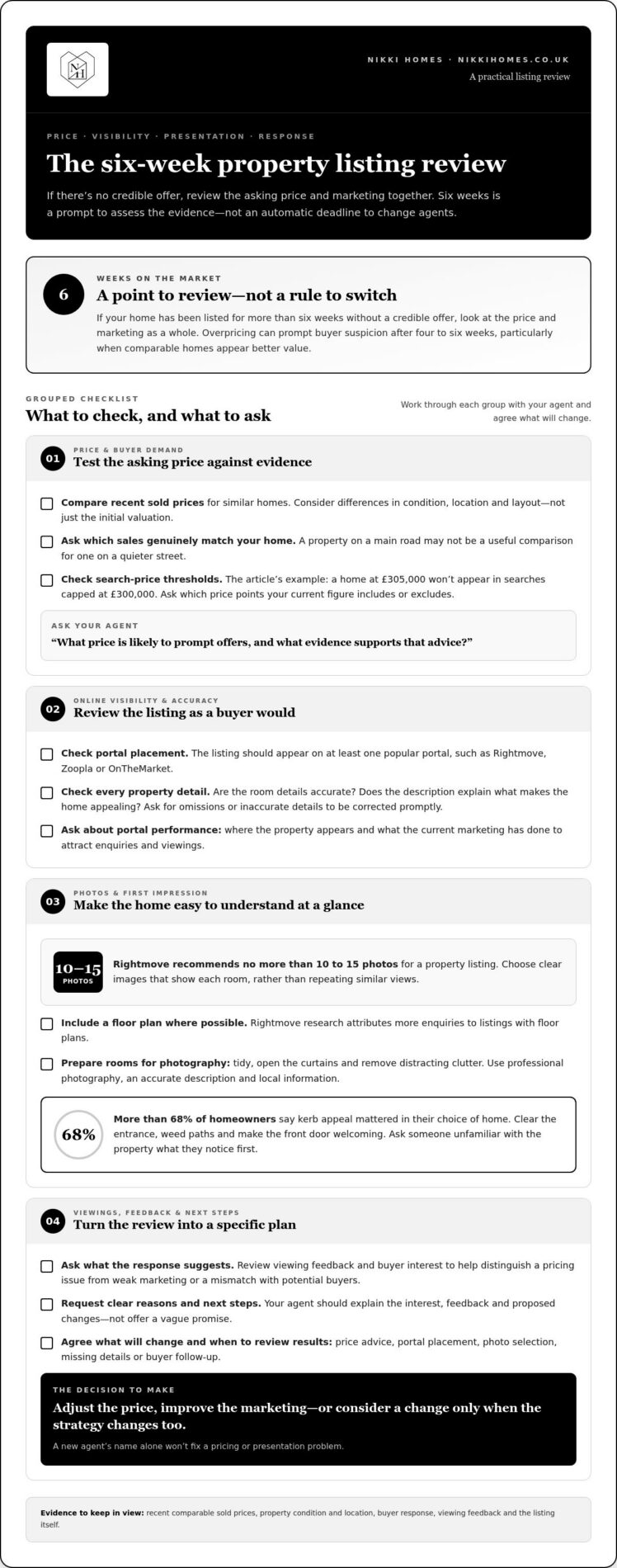
Use six weeks as a review point, not an automatic deadline to change agents. If your property has been listed for more than six weeks without a credible offer, review the asking price and marketing together. Overpricing can prompt buyer suspicion after four to six weeks, particularly when comparable homes appear better value. Don’t wait for the listing to grow stale before asking what the response suggests.
Start with the valuation. Compare the asking price with recent sold prices for similar homes, then consider differences in condition, location and layout. An asking price of £305,000 won’t appear in searches capped at £300,000. A listing at £310,000 may reach buyers searching up to that threshold. Ask your agent which price points your current figure includes or excludes.
Check where the property appears online. The listing should feature on at least one popular portal, such as Rightmove, Zoopla or OnTheMarket. Review the advert as a buyer would: are the room details accurate, and does the description explain what makes your home appealing? Ask your agent to correct omissions or inaccurate details promptly.
Strong presentation gives buyers a reason to book. Use clear, professional photography, an accurate description, local information and a floor plan where possible. Rightmove recommends no more than 10 to 15 photos for a property listing, while its research attributes more enquiries to listings with floor plans. Choose images that show each room clearly, rather than repeating similar views.
Improve the listing’s first impression by tidying rooms, opening curtains and removing distracting clutter before photography. For kerb appeal, clear the entrance, weed paths and make the front door welcoming. More than 68% of homeowners say kerb appeal mattered in their choice of home, so ask someone unfamiliar with the property what they notice first.
Give your agent specific points to address: portal placement, photo selection, missing details, viewing feedback and the asking price. Agree what will change and when you’ll review the results. If viewings remain limited, the response can help distinguish a pricing problem from weak marketing or a mismatch with potential buyers.
4. How can my estate agent improve viewings and offers?
Ask for evidence, not a vague promise to “push harder”. Your agent should explain why buyers aren’t booking viewings, what the feedback says and what price could prompt offers. Request clear answers about the listing’s performance and a practical next step for each problem. If the asking price is the barrier, you need a reasoned recommendation, not another unsupported valuation.
Use viewing feedback to find the sticking point. Ask your agent to record what each potential buyer liked, what concerns they raised and why they didn’t make an offer. If several buyers mention the same issue, discuss whether a change to the price, presentation or viewing arrangements could address it. A clear pattern is more useful than a general comment that the market is quiet.
Make viewings straightforward to arrange. Ask whether your agent responds promptly to enquiries, offers a range of appointment times and follows up after each visit. If buyers struggle to view while you’re at work, agree practical access arrangements that suit your household. Then ask which enquiries became viewings and what happened next.
Consider whether an open day suits your property and likely buyers. In one example, an estate agent held two open days to attract potential buyers. Ask your agent what audience an event would target, how invitations would be handled and how interest would be followed up. An open day should support a clear plan, not replace one.
Before your next review, agree what your agent will change and how you’ll assess the response. Set out whether the next step is sharper buyer follow-up, a revised price recommendation or a different viewing approach. Keep the discussion focused on actions and feedback, then compare the results with the previous campaign. This gives you a firmer basis for deciding what to do next.
If you want a fresh perspective on your sale plan, discuss your property’s selling strategy.
Nikki Homes: Residential Property Sales
Nikki Homes provides residential property sales for homeowners who want a considered review of their sale and marketing approach in Stratford-upon-Avon. If you’ve reviewed the asking price, listing and agreement but still lack a clear way forward, discuss your property and priorities with the team, then consider how a sales strategy could address them.
A change of agent is useful only when the plan is clear. Be ready to explain your current asking price, buyer feedback and what you want to achieve. Nikki Homes also provides lettings services, property sourcing and property auctions for different property needs.
Contact Nikki Homes to discuss your property sale.
Choose your next move with clarity
If you’re wondering why your estate agent is not selling your house, focus on the outcome you need, not just the frustration you feel today. A sale involves more than securing an offer: your timing, onward plans and confidence in the proposed strategy all matter. Take time to weigh those priorities before agreeing to a change.
A useful next conversation should be specific. Set out what you want to achieve, what has stalled and what you need from an agent now. That gives you a stronger starting point for deciding whether to reset your approach or move forward with a new one. Nikki Homes can discuss your property and the next step that fits your plans.
Contact Nikki Homes for help with your next move, and take the next step with a clearer sense of direction.
Frequently Asked Questions
How does pricing affect the sale time?
Pricing shapes which buyers consider your home and whether they arrange a viewing. If similar properties offer more space or a better location at a comparable asking price, buyers may choose them first. A price grounded in recent, genuinely comparable sales gives buyers a clearer reason to act. Review the response to your advert alongside the properties buyers are viewing, not in isolation.
How long is too long when selling a house?
More than six weeks without a credible offer is a useful point to review the sale, not a deadline that automatically means failure. Look at the whole pattern: whether enquiries lead to viewings, what visitors say and whether comparable homes are attracting interest. If the listing has been quiet throughout, ask for a fresh assessment now rather than waiting for time on the market to solve the problem.
Why didn’t the property sell?
A property can remain unsold when its price, presentation or appeal doesn’t align with buyer expectations. For example, a listing may attract online attention but few bookings if its photographs don’t show the layout clearly. Few enquiries can point to a price or visibility issue, while regular viewings without offers may suggest a mismatch in value or condition. Compare these signals before choosing a remedy.
Why might my estate agent not be selling my house?
If your estate agent isn’t selling your house, the cause may be the strategy, not simply a lack of effort. Ask for a clear account of buyer enquiries, viewing feedback and follow-up, then compare it with the listing’s price and presentation. If you receive no specific explanation or proposed action, put your concerns in writing and request a response through the agency’s complaints process.
How long does it usually take to sell a house in the UK?
The UK average is 64 days to reach a sale subject to contract. That means an agreed sale, not a completed move, so it’s useful to distinguish the milestone when judging progress. A particular property may take more or less time depending on its price, location, condition and buyer demand. Track your own enquiries and offers against those factors rather than treating the average as a deadline.
How can I tell if my house is overpriced compared with similar local properties?
Compare recent completed sales, not just current asking prices, and choose homes with similar size, condition and location. A home on a quieter road may not match one beside a busy route. Those differences show why context matters.