
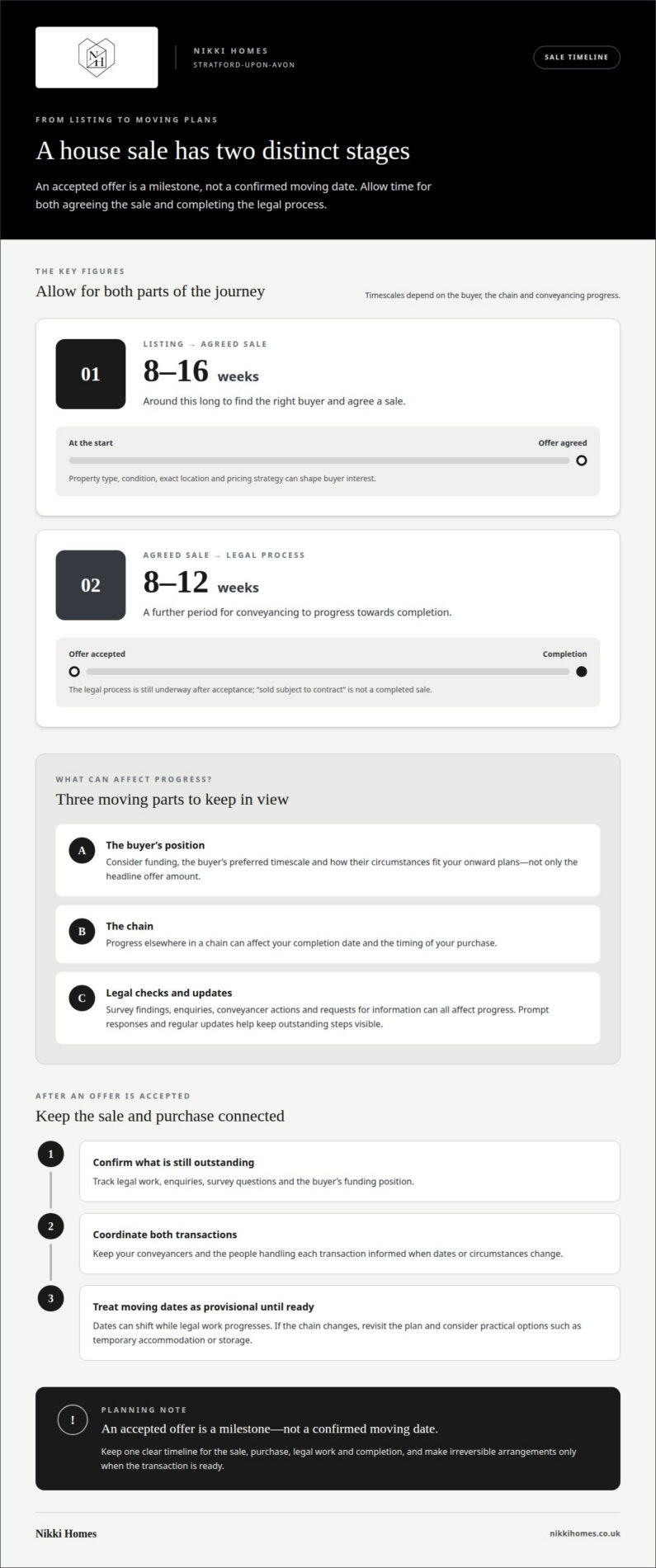
A sale is only the first half of the move. If you’re selling your house and moving to Stratford-upon-Avon, allow around 8 to 16 weeks from listing to agreeing a sale, followed by another 8 to 12 weeks for the legal process. The timetable depends on finding the right buyer and keeping the chain and conveyancing moving.
When selling my house and moving to Stratford-upon-Avon, it’s easy to focus on the offer, but acceptance is not the finish line. The next steps affect when you can make firm plans, so it helps to understand what happens after an offer as well as how long a sale may take.
This guide explains the factors that affect selling times, how offers are assessed and what sales progression involves. It also looks at the local estate agency support available across Stratford-upon-Avon and Warwickshire, so you can plan your move with a clearer view of the process.
Key Takeaways
- Understand how your property type, location and pricing strategy can shape the sale, then use that insight to plan your next move.
- Look beyond the offer amount: the buyer’s position and the strength of any chain can affect how smoothly a sale progresses.
- Know what happens after an offer is accepted, so you can anticipate the legal steps and keep the move on track.
- See how locally informed sales support and in-house mortgage and financial advice can help bring your sale and onward plans together.
Selling a property in Stratford-upon-Avon and the surrounding region
Stratford-upon-Avon has period houses, new-build homes, apartments and terraced houses. To judge how your home may appeal to buyers, consider its type, condition and exact location rather than relying on a single figure for the whole area.
Local property knowledge
Local property knowledge helps explain how a home’s setting and character may influence buyer interest. Area figures provide context, but they are not a valuation of an individual property.
In Worcestershire, assess each home against its own location, features and likely buyer appeal rather than using a Stratford-upon-Avon figure as a direct comparison.
Estate agency and valuations
An estate agency valuation is an informed estimate of a property’s market value, based on its features and relevant local evidence. Asking terms provide context, but they are not evidence of completed sale prices.
A useful valuation considers the property type, condition, location and comparable homes before recommending a pricing strategy suited to your goals. Ask how the figure was reached and how the asking price is intended to position your home for buyers.
The total cost of buying in Stratford-upon-Avon depends on the agreed price, your circumstances, Stamp Duty and conveyancing costs. Local average prices provide context, but they cannot determine your exact total.
Council tax depends on the property’s band and the applicable local rate. Check both for the specific address when calculating ongoing costs.
For a leasehold, new-build or chain-free purchase, review the relevant terms, condition and transaction arrangements. Leasehold costs depend on the lease and its charges. New-build buyers should consider the property’s finish, while chain-free does not remove the need for conveyancing or property checks.
Offers and sales progression
Sales progression means moving an accepted offer through legal checks towards completion. Selling my house and moving to Stratford-upon-Avon involves coordinating a sale with an onward purchase, where progress on either transaction can affect the other.
Residential sales
Residential sales transfer ownership of homes. Look beyond an offer’s headline amount: the buyer’s funding position, chain and preferred timescale all matter. Selling my house and moving to Stratford-upon-Avon calls for a clear understanding of how the buyer’s circumstances fit with your own purchase plans.
After an offer is accepted, the agent can help keep communication moving between the parties and their conveyancers. “Sold subject to contract” means an offer has been accepted, but the legal process is still underway. Do not treat this as a completed sale or make irreversible moving arrangements before the transaction is ready.
Selling and buying steps
The process runs from marketing your home through to completion of both transactions. Prepare the property, consider offers and, once you accept one, have conveyancers progress the legal work while you arrange the onward purchase. Keep both sides informed. The buyer’s funding, survey findings, enquiries and chain can all affect progress.
Track which tasks are complete and which still need attention. If a survey raises questions or the buyer’s circumstances change, clarify the effect on both transactions before adjusting your plans. An accepted offer is a milestone, not a confirmed moving date.
After-sales support means continued coordination after an offer is accepted. Regular updates can clarify outstanding enquiries, conveyancer actions and dependencies in the chain. Responding promptly to requests for information can help avoid unnecessary delays.
For a linked sale and purchase, ask for a joined-up view of the next steps and any changes affecting timing. A coordinated residential sales process can help keep the moving parts visible as the transaction progresses.
Estate agent support throughout the moving process
Treat your sale and purchase as linked transactions, not separate plans. To reduce the chance of a gap between homes, keep key dates, the chain position and outstanding steps clear to everyone involved.
Move coordination
Move coordination means aligning your sale, purchase and moving dates. An agent can track progress on both transactions, pass on updates and flag delays that may affect your plans. For a move to Stratford-upon-Avon, keep the onward purchase connected to the sale of your current home, rather than treating an accepted offer as the final milestone.
Keep one clear timeline for the sale, purchase, legal work and completion. Tell your conveyancer when dates change, and ensure everyone handling each transaction understands which decisions depend on the other property. If your purchase is in a chain, a delay elsewhere can affect your completion date.
Avoiding a gap between properties
A gap between properties occurs when you must leave your current home before you can move into the next one. To reduce the risk, align expected completion dates and keep communication active as conveyancers progress both transactions. Dates can shift, so do not treat a proposed moving day as settled until the legal work is ready.
Ask for updates on specific outstanding steps, such as enquiries, mortgage arrangements or an agreed completion date. If the chain changes, revisit the plan promptly. This gives you time to consider practical options, such as temporary accommodation or storage, instead of being caught out by a last-minute change.
Moving within Stratford-on-Avon District also involves council administration. According to Stratford-on-Avon District Council, residents moving within the district should complete a Moving Home Vacating form for the old address and a Moving Home Occupying form for the new one. Submit both promptly to help keep council services and accounts up to date.
Keep a shared record of agreed dates, open questions and next actions. A brief update after each milestone can help you spot a stalled transaction before it disrupts your move.
Location in Warwickshire and nearby places
A location profile describes how a place’s setting shapes daily life and a property purchase. Stratford-upon-Avon sits in Warwickshire, about 90 miles northwest of London and 22 miles southeast of Birmingham. Warwick is eight miles away, while Birmingham International Airport is 18 miles from town. These connections help frame travel plans, but check the journey that matches your regular route.
The River Avon runs through Stratford-upon-Avon, with Bancroft Gardens beside it. The town is also known as William Shakespeare’s birthplace. Its centre has independent boutiques, national chains, chemists, opticians, a post office and supermarkets including Waitrose and Marks & Spencer. Local markets can be one feature to consider when comparing amenities. These landmarks can help you compare neighbourhoods and nearby amenities.
For a purchase near the river, check the specific address’s flood risk and relevant property history. Find out whether it is in a conservation area or is a listed building, and ask your conveyancer how any designation or restriction may affect planned changes and upkeep. These checks are property-specific, so do not assume nearby homes have the same status or risks.
Stratford-upon-Avon has public, private and grammar schools, as well as a leisure centre within walking distance of the town centre. Golf courses are available in Stratford, Bidford, Welford and Chipping Campden. Compare the routes and facilities that matter to your household instead of choosing by place name alone. The rail journey to London takes around two hours.
Warwickshire includes nearby places with distinct settings, from Warwick to Bidford and Welford. If you’re weighing up locations alongside a sale, consider your preferred connections, amenities and property requirements together. Discuss your Warwickshire move to explore how local property choices fit your plans.
Nikki Homes: In house mortgage and financial advice
Nikki Homes can connect your property plans with its in-house mortgage and financial advice. If you’re selling your current home while arranging a purchase in Stratford-upon-Avon, understanding how the two transactions fit together can help you make informed decisions about your next steps.
Nikki Homes’ residential sales service can support you as you prepare to sell, while in-house mortgage and financial advice can help you consider the purchase alongside your sale. Discuss your priorities, timescale and practical questions, then decide what support best fits your circumstances.
For a joined-up conversation about selling and moving, contact Nikki Homes to discuss your plans.
Make your next move with a clear plan
Selling your house and moving to Stratford-upon-Avon is a major decision, but you can start by identifying what matters most. Decide whether you need to sell first, rent while you search, or source a property that fits your requirements. A clear priority makes it easier to plan the route ahead.
Nikki Homes offers residential property sales, lettings and property sourcing to support different routes into your next home. Whether you’re preparing to sell, considering renting or looking for a property to buy, the right starting point depends on your plans and circumstances.
Contact Nikki Homes about your move to discuss your next steps. With a considered plan, you can move towards Stratford-upon-Avon with greater clarity and confidence.
Frequently Asked Questions
How long does it take to sell a property?
Allow 8 to 16 weeks from listing to agreeing a sale, then another 8 to 12 weeks for the legal process. The UK average from listing to contract is 64 days, according to Nikki Homes’ published information. Treat averages as planning guidance, not a completion date: buyer funding, survey findings, conveyancing enquiries and the length of the chain can all affect progress.
What fees do estate agents charge?
Estate agency fees depend on the service and are provided after a quote request. Costs can vary with the scope of the service, marketing arrangements and property requirements. Before instructing an agent, check what the agreed fee covers and when it is payable. A valuation is separate: Nikki Homes provides a completely free, honest property valuation with no contract obligation.
When is the best time to sell a house?
There is no single best month to sell every home. The right timing depends on your plans and the buyers likely to want your property. Consider your onward move, the home’s presentation and whether you have time to prepare it properly before launch. A well-planned listing is more useful than rushing to market for a supposedly perfect season. Use local comparable sales to inform your timing and asking price.
How much does it cost to sell a house in the UK, including estate agent and solicitor fees?
There is no single total cost for selling a UK home. Agent and solicitor fees depend on the service and legal work required, as well as the complexity of the transaction. Request a clear breakdown of proposed charges and what each covers, then budget for any additional work that arises during the sale.
What are current house prices in Stratford-upon-Avon by property type and area?
Town-level averages are not guaranteed values for a particular address. Prices vary with location, condition and property features, so compare homes with a similar type and setting. Asking prices in nearby Warwickshire villages can differ substantially from completed sale prices.
What are the best areas to live in Stratford-upon-Avon for families, commuters and retirees?
The best area depends on your daily priorities, not a universal ranking. Families may weigh school options and access to amenities; commuters can consider Stratford-upon-Avon’s rail journey to London, which takes around two hours. Retirees may prioritise town-centre shops, the leisure centre or quieter nearby places such as Bidford and Welford. Visit the areas you’re considering and assess the routes and facilities you would use regularly.