An online estimate is a starting point, not the final word on your home’s value. If you’re asking how much your house is worth in Stratford-upon-Avon, the answer depends on its usable living space, exact location, condition and the homes buyers are comparing it with. The provisional average house price in Stratford-on-Avon was £397,000 in August 2026, but a district-wide average is a benchmark, not a valuation of your individual property.
Online tools offer a quick snapshot, but they cannot fully reflect a home’s layout, the differences between Stratford-upon-Avon streets or what local buyers are looking for. Those details matter when you’re deciding whether to sell and at what price.
This guide explains how living space and location affect comparisons, what local price trends can tell you, and why a property-specific valuation offers more than an automated estimate. The aim is to give you a clearer picture of your home’s position in the Stratford-upon-Avon market.
Key Takeaways
- Compare your home with similar local properties, paying close attention to usable internal space rather than bedroom count alone.
- Consider how proximity to the town centre, riverfront, schools and transport links may shape buyer demand for your location.
- Use regional and national averages as context, then focus on the property type and local comparisons that best match your home.
- When you’re weighing up a sale or your next move, a tailored valuation and relevant financial advice can help you understand your options.
How living space can inform property comparisons
Floor area makes comparisons fairer, but square footage alone cannot determine a Stratford-upon-Avon home’s value. Layout, condition, gardens, parking and location all influence buyer appeal. Compare homes with similar usable living space, then account for visible differences. Check how each listing treats a garage: some include it in the stated area, while others list it separately from living accommodation.
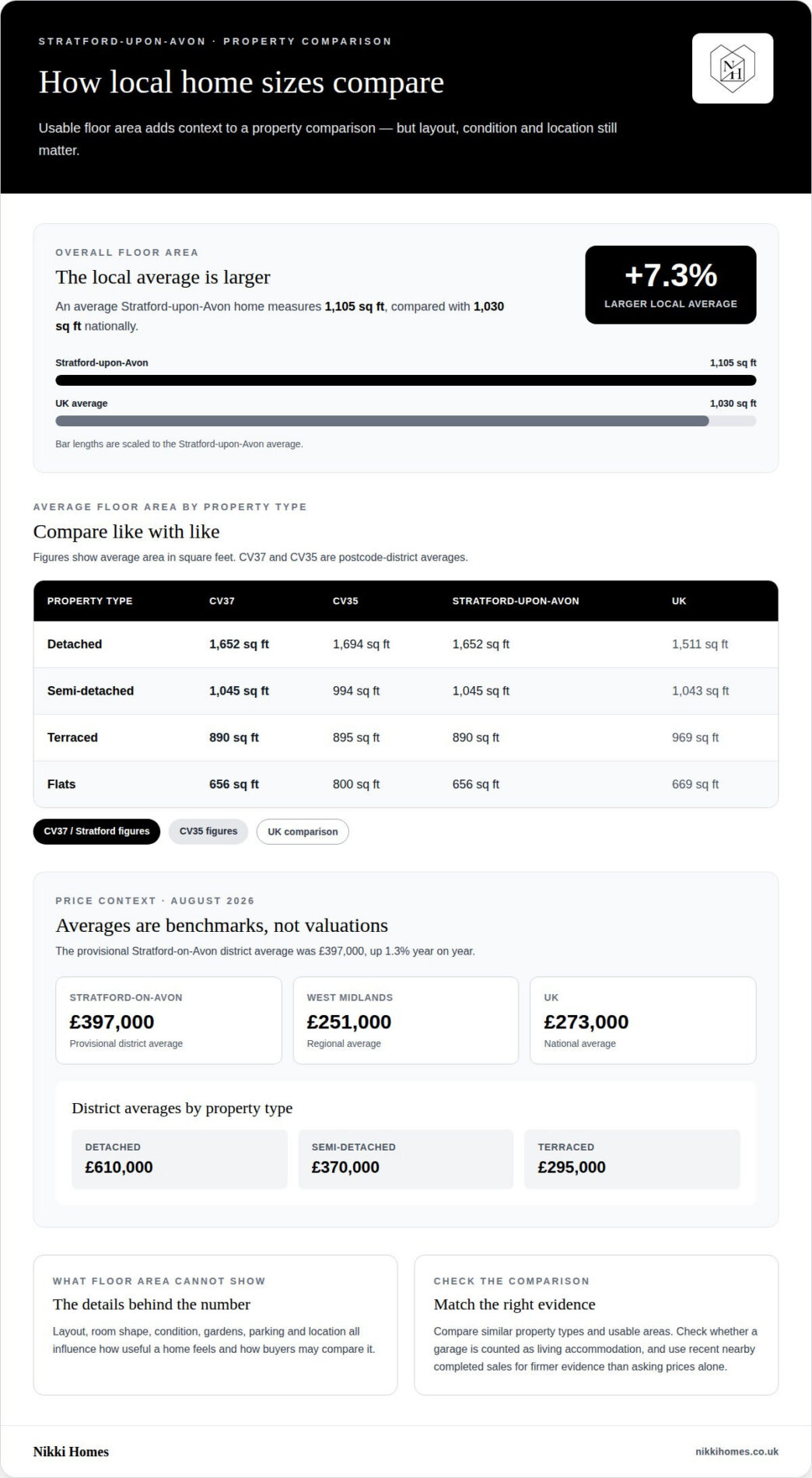
Local averages show how sizes differ by property type. In CV37, detached homes average 1,652 sq ft, semi-detached homes 1,045 sq ft, terraced homes 890 sq ft and flats 656 sq ft. In CV35, the averages are 1,694 sq ft for detached homes, 994 sq ft for semi-detached homes, 895 sq ft for terraced homes and 800 sq ft for flats. Use the figure that matches your home type and postcode district.
Current listings show why size needs context. These are asking prices, not completed-sale evidence; location, finish and features also affect the comparison.
Asking prices in Stratford-upon-Avon are reduced by an average of 1.5%. Recently listed and reduced properties can indicate how sellers are adjusting expectations, but compare their asking prices with completed local sales before drawing conclusions.
Selling costs can include agency fees, conveyancing, mortgage exit charges, preparation and moving expenses. The costs depend on your circumstances, the property, the service and the work involved; request a quote based on your situation.
For your address, look for sold properties nearby with a similar type, usable area, condition and layout. Recent local sales provide firmer evidence than asking prices alone.
A face-to-face valuation can take account of your home’s layout, presentation and buyer appeal, as well as local comparisons. Before marketing, clear photographs and accurate room dimensions help show the usable space. Tidy rooms and gardens also make the property easier to assess.
Price premiums near the town centre and riverfront
Location can affect value even when homes have similar floor areas. Homes near Stratford-upon-Avon town centre and the riverfront tend to command higher prices. Buyers may value walkable amenities, riverside surroundings and access to schools. Conservation-area restrictions can affect plans for external changes, while flood exposure may influence buyer perceptions and lending decisions. The exact address and condition therefore matter.
For property-type context, Stratford-on-Avon’s August 2026 average prices were £610,000 for detached homes, £370,000 for semi-detached homes and £295,000 for terraced homes. These are averages, not the sale price for every home.
Read neighbourhood averages alongside comparable completed sales. The town-centre and riverfront premium is a useful local signal, but street, condition, layout and property type still shape a fair comparison.
The provisional average house price in Stratford-on-Avon was £397,000 in August 2026, up 1.3% year on year. First-time buyers paid an average of £308,000, while home-movers paid £473,000. These figures describe different buyer groups, not a guaranteed value for a particular property.
Improvements can increase appeal, but the spend should suit the home and its likely buyers. Updated kitchens and bathrooms, fresh decoration, minor repairs, landscaped gardens, parking and kerb appeal can all improve presentation. An estate agent can weigh these features against local demand, but an expensive upgrade will not automatically return its full cost.
For a grounded view of how location and presentation affect your sale, explore local property valuation advice.
Stratford-on-Avon compared with regional and national averages
In August 2026, Stratford-on-Avon recorded the West Midlands’ highest average house price. The regional average was £251,000; the UK average was £273,000. These figures frame the housing market, but cannot price an individual address. A broad average can hide differences between property types, locations and condition.
Floor area offers another useful comparison. The average Stratford-upon-Avon home measures 1,105 sq ft, against 1,030 sq ft nationally. That makes the local average 7.3% larger. Yet floor area alone doesn’t reveal how useful the space feels. Bedrooms, room shape and layout all affect whether a home suits buyers’ needs. Compare properties with similar accommodation, not just similar postcodes.
Property type changes the picture. Stratford-upon-Avon detached homes average 1,652 sq ft, against 1,511 sq ft nationally, a 9.3% difference. Semi-detached homes average 1,045 sq ft locally and 1,043 sq ft nationally. Terraced homes average 890 sq ft locally, compared with 969 sq ft across the UK. Flats average 656 sq ft locally, against 669 sq ft nationally.
An online estimate can provide an initial indication based on property details and wider market patterns. It may miss a renovated kitchen, unusual layout, condition or distinctive features. An in-person valuation can assess those details alongside recent improvements, comparable local sales and buyer demand. This gives the estimate a property-specific basis rather than relying on averages alone.
Use national figures as context, then narrow the comparison to relevant homes. Match property type, usable area, bedrooms and condition before considering local sales. For example, compare a Stratford flat with other flats, not with the town’s larger detached homes. This keeps the comparison relevant and helps explain why an individual property may sit above or below broad market benchmarks.
The relevance of usable living space to home pricing and buyer appeal
In Stratford-upon-Avon, usable space matters alongside bedroom count and condition. Buyers consider whether rooms work for everyday life, not just how many appear on the floor plan. A home with generous bedrooms but an awkward layout may compare differently with one offering flexible, well-presented living areas. Maintenance and improvements also influence how much work buyers expect after moving in. Together, these details shape appeal and the price a property may achieve.
Properties in Stratford-upon-Avon spend an average of 14 weeks on the market. That figure gives useful context, but it cannot predict an individual selling timescale. Buyer demand and available housing supply influence how quickly homes attract interest. When demand exceeds supply, prices can rise and sealed bids or full and final offers may occur. When supply exceeds demand, prices tend to be lower and negotiation happens more often.
Market conditions affect how buyers respond to size and presentation. In a competitive local market, practical living space and good condition can help a home stand out. When buyers have more choice, they can compare layouts, maintenance needs and asking prices more closely. The same number of bedrooms may therefore appeal differently depending on how the rooms function and what else is available.
For a clearer view, assess your home in context: compare its usable space and condition with similar local properties, then consider current buyer demand. A spacious extension, for example, adds appeal when it provides useful accommodation and suits the home’s layout. It won’t automatically translate into an equal increase in value. If you’re preparing to sell, talk through your selling plans and how your property’s features may influence its position in Stratford-upon-Avon’s market.
Nikki Homes: In house mortgage and financial advice
Nikki Homes can help you connect your property’s value with your next decision. If you’re considering selling, its residential sales service can support your move. If you’re weighing up a purchase, in-house mortgage and financial advice can help you consider your options. Lettings and property sourcing may also suit plans to rent out a home or find another property.
A valuation is one part of the decision. Your plans, finances and preferred timescale matter too. Discussing them together can help you choose your next step, whether you’re preparing to sell, exploring a move or considering another option.
Contact Nikki Homes to discuss your property and what you’re considering.
Make your next property decision with clarity
A valuation is most useful when it helps you decide what to do next. Consider your priorities: selling, letting your property or finding somewhere else to live. The right route depends on your plans, not just a figure on a page. If you’re still weighing up how much your house is worth in Stratford-upon-Avon, a property-specific discussion can put the question in context.
Nikki Homes supports residential sales, lettings and property sourcing, giving you options to consider as your circumstances take shape. Share your plans and priorities, whether you’re preparing to move or exploring alternatives.
Contact Nikki Homes about your valuation and take a considered step towards your next move.
Frequently Asked Questions
Why do I need to book a property valuation when I can get one online?
A valuation can account for details an automated estimate may miss, such as alterations, unusual room arrangements and visible maintenance needs. Two homes with the same number of bedrooms, for example, may differ in usable space or finish. Nikki Homes provides a completely free, honest property valuation. No pressure. No contracts. No questionable tactics. No half measures. It gives you a property-specific starting point for deciding what to do next.
Does location affect price?
Yes. Location can influence which buyers are interested and which features they value. A home near a school may suit buyers who prioritise access to schools, while transport links may matter to commuters. Employment opportunities and community amenities can also shape demand. Consider how the immediate surroundings fit a likely buyer’s priorities instead of assuming every Stratford-upon-Avon address attracts the same interest.
How do nearby areas compare?
Nearby areas can differ in property mix and typical floor area, so compare like with like. For example, detached homes in postcode district B50 average 1,389 sq ft. That figure is a size reference, not a local house-price average. A useful comparison pairs your home with similar nearby properties, considering type, condition and accommodation, rather than treating postcode boundaries as a direct measure of value.
How much is my home worth?
Your home’s value depends on its features and evidence from relevant local sales. To understand how much your house is worth in Stratford-upon-Avon, consider its condition, usable space, layout, location and current buyer demand together. An asking price is not the same as a completed sale price. If you’re preparing to sell, a property-specific valuation can help establish a realistic starting point.
How have prices changed?
Changes vary by property type, so one overall trend may not describe your home. In Stratford-on-Avon, flat prices decreased by 1.5% in the year to August 2026, while terraced property prices rose by 2.2% over the same period. These contrasting movements show why it helps to focus on the type of home you own and the buyers most likely to consider it.
How important is property condition?
Condition shapes both a buyer’s first impression and the work they expect after moving in. A well-maintained home with functioning fittings and cared-for rooms presents differently from one with visible repairs to make. Before viewings, focus on issues buyers are likely to notice, such as damaged surfaces, tired decoration or an untidy entrance. Clear presentation helps them assess the space without avoidable distractions.