
The village that looks like the obvious choice on a map may not suit your daily routine. If you’re comparing wilmcote warwickshire with Norton Lindsey, the useful question isn’t which sounds more appealing. It’s which fits the way you live, travel and want to use your home.
Both villages have rural character, but the practical details differ. Wilmcote has its own railway station, village shop, pub and primary school. Norton Lindsey has a cricket club and bus connections, but you’ll need to see how those transport options fit your regular journeys. Property prices also merit a closer look: average sold prices over the last year to October 2026 were £542,139 in Wilmcote and £693,667 in Norton Lindsey. The types and mix of homes sold can affect those figures.
This comparison gives you a consistent way to weigh everyday priorities, property details and local considerations without treating a village’s reputation as proof that it’s right for you. Use it to identify what to check, from transport and amenities to the homes available, so your property search starts with clearer priorities and fewer assumptions.
Key Takeaways
- Compare Wilmcote and Norton Lindsey against your daily routine, not a generalised picture of village life.
- Use wilmcote warwickshire as a starting point to check local boundaries, amenities and transport details against reliable, current information.
- Separate asking prices from completed-sale evidence, and assess each home’s condition and features individually.
- Map the journeys you make regularly, then revisit both villages at times that reflect your normal routine.
- Score each location against the same personal priorities to identify the trade-offs you’re willing to make.
Wilmcote, Warwickshire: what should you compare with Norton Lindsey?
A village can look idyllic in a guide and still be awkward for your daily routine. You might need a dependable journey to work, room for a growing household or easy access to particular services. A polished description won’t tell you whether the school run, commute or property will work in practice. The real comparison is not which village sounds better, but which suits the life you lead.
Wilmcote and Norton Lindsey are both in Warwickshire. But a county label alone doesn’t give you a complete picture of a property’s location. Check the address and position on a current map, then verify parish and local authority details through relevant council information. Boundaries and distances can affect which services and routes matter, so check the specific home rather than relying on a broad village label.
This is a decision aid, not a league table. It won’t declare a winner or predict what living in either place will feel like. Instead, it gives you a consistent way to investigate factors that could affect your decision before you arrange viewings or narrow your search.
What this Wilmcote and Norton Lindsey comparison can, and cannot, tell you
Use confirmed information as a starting point, and distinguish it from your interpretation. A published transport route or an advertised property feature can be checked; whether a location feels convenient or a home feels right is personal. Amenities, services, routes and listings can change, so check current details before relying on them. Avoid treating village reputation as proof of safety, community character, demand or value.
For historical and geographic background on Wilmcote, the Wilmcote, Warwickshire Wikipedia page provides useful context. Use it for orientation, not as a substitute for current council information, transport timetables or property particulars. For details that could affect your decision, refer to those current records.
Start with the routines that shape village life
Before comparing either place, write down what an ordinary week requires. Include regular journeys, household needs and the surroundings you prefer. Give a daily journey more weight than a destination you visit occasionally. Then apply the same criteria to both villages, so attractive photos or a strong first impression don’t give one an unfair advantage.
- Journeys: Where do you travel regularly, and at what times?
- Household needs: Which nearby services, schools or facilities matter to you?
- Home priorities: What space, condition and property features are essential?
- Surroundings: What kind of setting do you want to come home to?
Write down what you know, what needs checking and what is simply your preference. Keeping these separate stops assumptions from being mistaken for facts. A village choice depends on your routines, priorities and property needs, not on a universal ranking of places. Keep that principle in mind as you compare Wilmcote and Norton Lindsey.
Wilmcote vs Norton Lindsey: compare setting and everyday access
A place can look close on a map but still make a regular journey awkward. Compare the trips you actually make, not a vague impression of which village is “better connected”. Wilmcote has a railway station, with direct services to destinations including Stratford-upon-Avon, Birmingham, London Marylebone, Leamington Spa and Worcester. Research for this comparison also identifies a Flexibus service linking Wilmcote with Stratford and nearby villages. Norton Lindsey has a Flexibus service to Solihull and a Stagecoach bus service to Henley High School. Routes, stops and timetables can change, so use these as starting points for checking your journey rather than as a promise that a particular service will suit it.
| Comparison point | Wilmcote | Norton Lindsey |
|---|---|---|
| Public transport starting point | Rail station; reported Flexibus connection to Stratford and nearby villages. | Reported Flexibus service to Solihull and Stagecoach service to Henley High School. |
| Stratford-upon-Avon | Check rail and Flexibus options for your destination and travel time. | Check current bus options and road routes for your exact destination. |
| What to verify | Station access, service times, connections and the walk or drive from the property. | Stops, operating times, connections and the walk or drive from the property. |
A fair village comparison applies the same criteria to both places, then weighs the results against your routine. The table is a framework, not a verdict. If you’re considering wilmcote warwickshire, whether its connections are convenient depends on your destination, travel time and how you’ll get there. Apply the same test to Norton Lindsey.
Check the journeys you would actually make
Start with work, school, shopping and healthcare trips that matter to your household. Enter the precise destination, not just “Stratford”, and compare routes at realistic travel times. Mapping estimates are useful, but they can’t guarantee your actual journey time. Check current rail and bus timetables and route information, including how you’ll reach the stop or station. For county-level transport and service information, consult the Warwickshire County Council official website.
Assess the surroundings without leaning on village clichés
Use a current map to check each property’s position, nearby roads and routes to places you use. A map pin can’t tell you how the surroundings feel. Visit both villages at different times, where practical, and note what matters to you, such as traffic, noise, walking routes or access to a stop. For wilmcote warwickshire, as for Norton Lindsey, keep your personal observations separate from measurable facts.
If both villages remain in contention, compare the actual homes as well as the routes. Once you’ve identified your priorities, local property advice can help you relate them to the homes available.
Compare homes in Wilmcote and Norton Lindsey beyond first impressions
A village name won’t tell you whether a particular house will suit your household. Compare the homes themselves, rather than an imagined “typical” property for either place. Look at current listings and reliable records, then weigh each home’s layout, condition and likely upkeep against your needs. A cottage with character may be a pleasure to own, or a poor fit if you need step-free access or don’t want ongoing maintenance.
Keep three kinds of evidence separate. An asking price is the seller’s current advertised figure. A completed sale records what a buyer paid for a particular property at a particular time. Condition is a separate question: two homes with similar layouts may need very different levels of work. None of these measures can stand in for the others.
Match the property to your household, not the postcard image
Start with the essentials: usable space, bedroom arrangement, storage, outdoor areas and access between rooms. Then consider how the home might work if your plans change. A spare room could become a study, for example, if its size and position suit that purpose. A garden may be a priority for one household and an unwanted maintenance commitment for another.
Be candid about the upkeep you’re prepared to take on. Older features, outbuildings or larger plots may appeal, but assess their condition and maintenance needs property by property. Don’t assume a feature is common in wilmcote warwickshire or Norton Lindsey based on a handful of photographs. Check the particulars, view the property and record anything you’d need to investigate further.
Read local listings and market evidence with care
For a meaningful comparison, shortlist properties that are broadly alike in type, size, condition and sale period. Compare a flat with a flat or a detached house with a detached house, rather than setting unlike homes against each other just because they share a village name. Record asking prices separately from completed-sale evidence, and note the date of each figure.
HM Land Registry’s Price Paid Data can help you review recorded residential sales in England and Wales. It won’t explain differences in condition, alterations or the circumstances of individual transactions, so treat it as evidence rather than a complete valuation. Asking prices show what sellers are seeking, not what a buyer will pay. An asking price alone cannot establish a home’s value, because it isn’t a completed sale and says nothing definitive about condition.
Make a simple comparison sheet for each property: advertised price, relevant sold evidence, room layout, outside space, visible condition and questions for a closer inspection. Keep observations distinct from facts, and don’t use one listing to make a claim about the whole village. For broader local context, consult the published Wilmcote village guide alongside current property particulars and records.
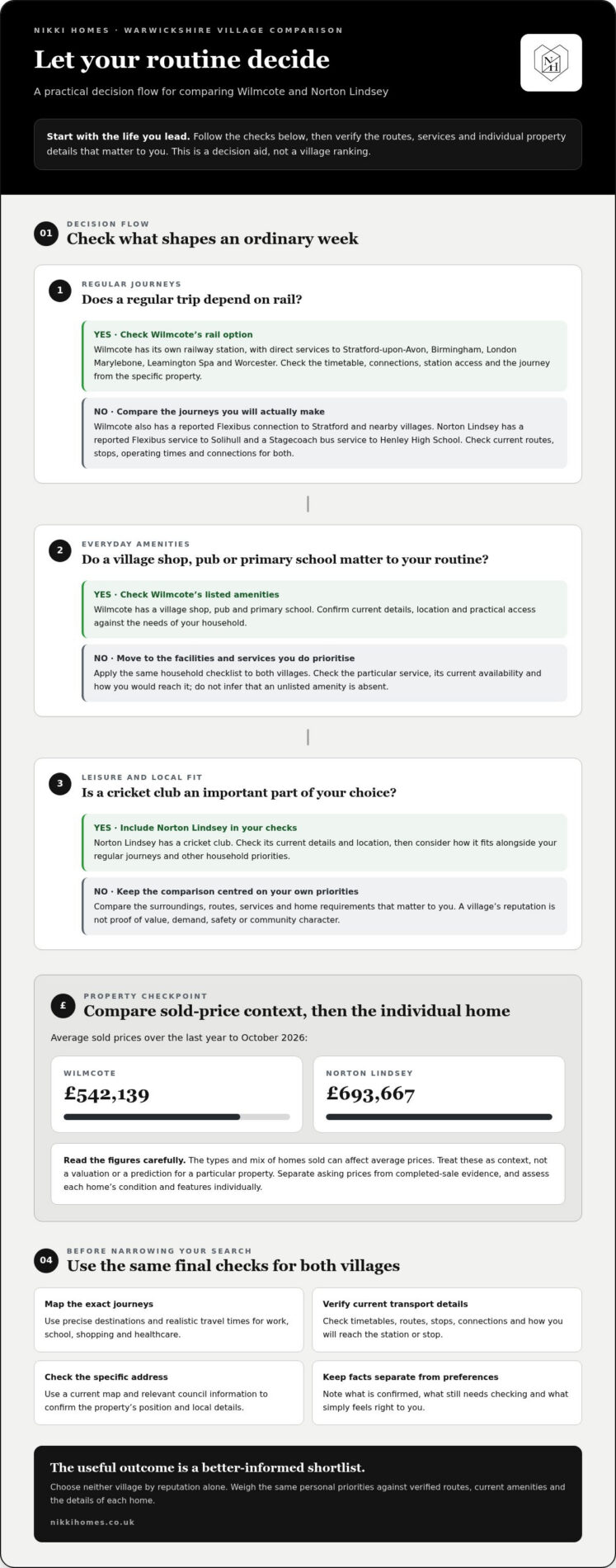
How to compare Wilmcote and Norton Lindsey before choosing
A reliable decision comes from a repeatable process, not a single viewing or a village’s reputation. Give Wilmcote and Norton Lindsey the same test. Record what you can verify, mark what still needs checking, and keep personal reactions in a separate column. A positive first impression can inform your choice without being mistaken for hard evidence.
- Set your priorities. Before looking at more listings, sort your needs into essentials, useful extras and genuine deal-breakers. Include household requirements, the kind of home you want and the regular journeys you need to make. Be honest about compromises: a preference isn’t automatically a must-have.
- Research both villages. Use current, reliable sources to check the services and facilities that matter to you. Verify school information directly with the relevant school or admissions authority, and check local boundaries and service details through official sources. Note when you checked each fact.
- Map your journeys. Enter the same regular destinations for both villages, such as work, school, shops or healthcare. Compare routes at the times you’d actually travel, then check current public transport routes and timetables with the relevant operators. Treat online journey estimates as estimates, not guarantees.
- Inspect homes consistently. Use the same viewing notes for every property: layout, condition, storage, outdoor space, access and features that may affect upkeep. Keep observations about a specific home separate from assumptions about the village. An advertised description is a starting point, not a substitute for seeing how the property fits your needs.
- Revisit before deciding. Where practical, return at a different time or on a different day. Note what you experience, then compare those impressions with the facts you’ve recorded. Score each village against your priorities, rather than an invented universal measure of the “best” place.
Build a shortlist that reflects real life
Keep the shortlist focused. A destination you travel to daily should carry more weight than somewhere you visit occasionally, and a household essential should matter more than an attractive extra. For each village, note whether a requirement is met, uncertain or unsuitable. This makes it easier to see what needs further research before a viewing, rather than discovering a practical mismatch afterwards.
Use one comparison sheet for both locations. Record the source beside each checkable detail, such as a school admissions page or a transport timetable, and label your own impressions clearly. If you’re also researching nearby areas, a separate local guide, such as a Shottery guide, is useful only if that location is genuinely part of your shortlist.
Use visits and evidence to test your assumptions
Revisit with a purpose. Walk or drive the routes you’d use and consider whether the journey works for your circumstances. A quiet visit can’t establish what every day will be like, but it can help you test a specific concern. Recheck details that may change, particularly school arrangements, transport services and local facilities, before relying on them.
Once you’ve set your criteria, discuss your property priorities with Nikki Homes for local guidance that can help bring your shortlist into sharper focus.
Which Warwickshire village fits your move? Make the decision on your terms
There’s no honest universal winner. Wilmcote may suit you if a railway station and its direct services align with journeys you make regularly. Norton Lindsey may work better if its current bus connections and available homes fit your plans. These are useful starting points, not verdicts: your experience depends on the specific property, destinations, timetable and household needs.
For a move to wilmcote warwickshire, weigh verified practical details against what you personally value. A feature that looks like a drawback on paper may be manageable if it brings a benefit you care about. Equally, a beautiful setting won’t compensate for a journey or home layout that consistently frustrates you. Be clear-eyed about the trade-off.
A simple decision rule for choosing between the villages
Start with the non-negotiables. If a regular journey, household requirement or property feature doesn’t work, don’t let a village’s reputation distract you from that gap. Then compare the genuine benefits of each option against its practical compromises. A longer journey, for example, may be acceptable if it’s occasional and the home better suits your needs. You decide how to balance those factors.
Before making a property decision, refresh the evidence. Recheck current listings, transport routes and timetables, relevant school information and details of the particular home. Separate what an official source or property record establishes from what you noticed during a visit. Resolve any material uncertainty before treating your shortlist as settled.
Turn a clearer shortlist into a confident next move
Once you know what matters, local property advice can make the next stage more focused. An agent can help you explore homes that match your brief, support a sale if you’re moving from another property and assist with onward negotiation as your plans take shape. For sellers, an honest valuation can inform the decisions that follow; it’s one part of the picture, not a substitute for your own priorities.
Nikki Homes is an independent, consultancy-led estate agency based in Stratford-upon-Avon. Its local property advice can help you turn a defined shortlist into a considered next step, whether you’re searching for a home or preparing to sell. There’s no need to force a decision before the facts and your priorities line up.
If you’re ready to explore your options, explore Nikki Homes’ local property services and take the next step at your own pace.
Make your next move with confidence
The strongest next step isn’t choosing a village on instinct. It’s turning your priorities into a property brief you can act on: what your home must offer, which compromises you can accept and what you still need to verify. That clarity can make viewings more focused and help you recognise a genuine fit, whether your search leads to wilmcote warwickshire or Norton Lindsey.
If you’re selling as part of the move, an honest valuation can help you plan your next decision with a clearer picture of your property. Nikki Homes is an independent boutique agency, with over 55 years of combined team experience, offering free honest valuations and consultancy-led property support. Straight advice matters when a move involves more than choosing a postcode.
Explore Nikki Homes’ local property services when you’re ready to take your shortlist forward. Keep your priorities clear, check the details that matter and make the decision on your terms.
Frequently Asked Questions
Is Wilmcote in Warwickshire?
Yes, Wilmcote is in Warwickshire, near Stratford-upon-Avon. For property research, the village name alone may not tell you which parish or local services apply to a particular address. Check the exact property location against current council information, especially if you’re comparing school admissions, local services or boundaries. This gives you a more useful answer than relying on a listing’s broad location description.
Does Wilmcote have a railway station?
Yes, Wilmcote has its own railway station. Services include direct trains to Stratford-upon-Avon, Birmingham, London Marylebone, Leamington Spa and Worcester, though routes and timetables can change. Before relying on the train for a commute or regular appointment, check the current timetable for the days and times you need. Also consider how you’d travel between the station and a specific property.
How far is Wilmcote from Stratford-upon-Avon?
The distance depends on your starting point in Wilmcote and destination in Stratford-upon-Avon, as well as whether you mean road, rail or walking distance. For a useful estimate, enter the exact property and destination into a current map or journey planner. If you’re travelling for work, school or an appointment, check the journey at the time you’d normally make it rather than relying on a general distance figure.
Can you walk between Wilmcote and Stratford-upon-Avon?
A walking journey may be possible, but check the precise route before setting out. The best option depends on your starting point, destination, route conditions and how much of the journey uses roads or paths. Use current mapping to plan it, then verify any public footpath details through relevant local sources. If walking is part of your regular routine, try the route in person before making it a deciding factor in a move.
Are there schools in Wilmcote?
Yes, Wilmcote has a Church of England primary school. It is an academy within The Stour Federation Multi Academy Trust, and Warwickshire Local Authority handles admissions. The school’s planned admission number is 15 for each year group, but that does not establish whether a place is available for a particular child. Check current admissions guidance and arrangements directly with the local authority before deciding where to live.
Is Wilmcote a good place to live?
It can be a good fit if the homes, facilities and journeys work for your household. Wilmcote, Warwickshire, offers a railway connection and village amenities, but those details don’t tell you whether a particular address suits your day-to-day life. Consider your commute, household needs, preferred surroundings and the property itself. Visit at different times, and base your decision on what you verify and experience rather than reputation alone.